The Amazing Light Spectrum
Light is everywhere – it helps us see the world, makes plants grow, and even lets us watch our favorite cartoons. But did you know that the white light we see is actually a secret mix of many colors? In this guide we’ll explore the Light Spectrum, learn new words, try a simple experiment, and discover why colors appear the way they do.
1. What Is Light?
Light carries energy in tiny packets called photons. Human eyes detect only a limited range of light wavelengths, called visible light.
- Wavelength – the distance between two peaks of a light wave. Shorter wavelengths make blue‑violet light; longer wavelengths make red light.
- Refraction – the bending of light when it passes from one material (like air) into another (like water or glass).
Cause & Effect: When light hits a prism, refraction separates the mixed photons into individual colors because each wavelength bends a different amount.
2. The Rainbow of Colors – The Spectrum
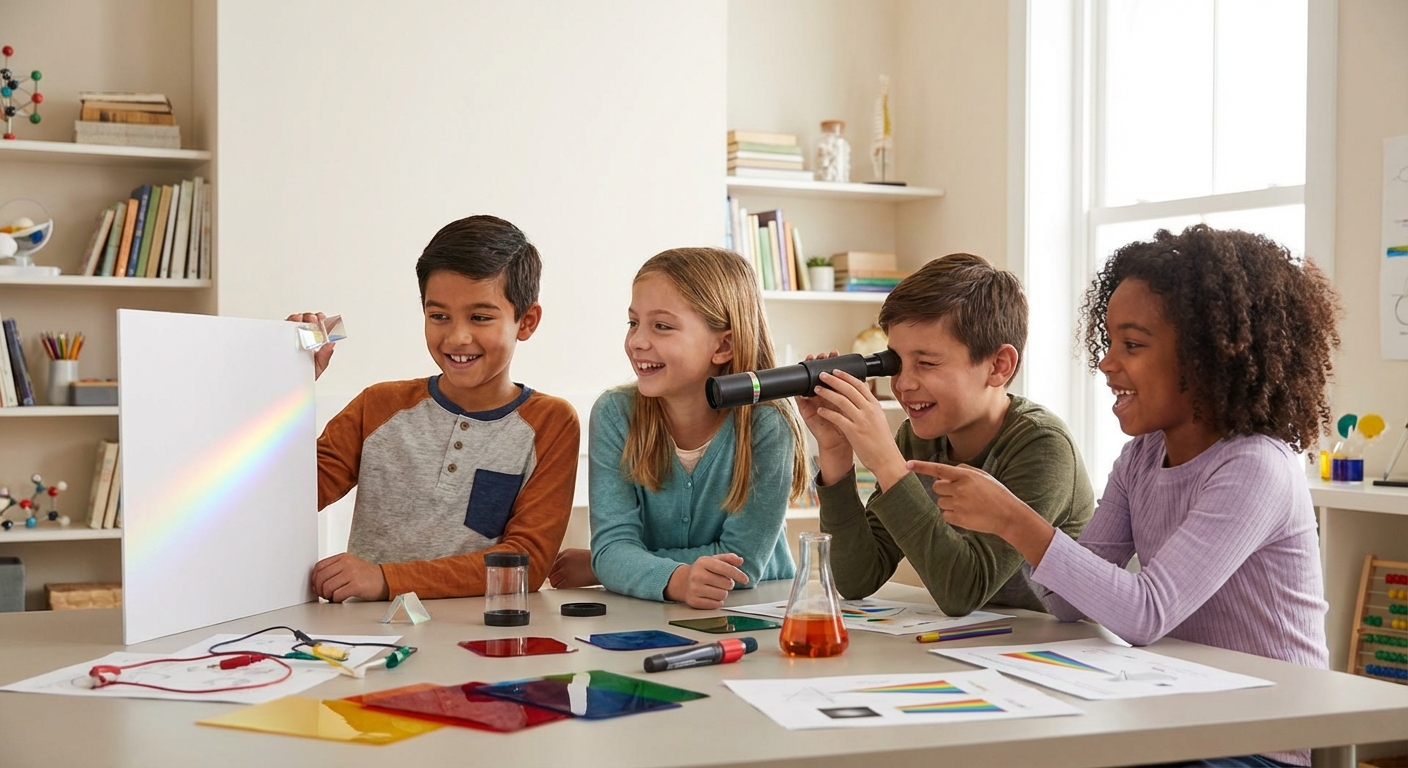
If you shine a flashlight through a glass prism, you’ll see a tiny rainbow. That rainbow is the Visible Spectrum, the part of light we can see. It runs in this order:
Red → Orange → Yellow → Green → Blue → Indigo → Violet
(A handy way to remember: Roy Gbiv.)
Did You Know?
- Sunlight is white because it contains All the colors of the spectrum mixed together.
- Some animals, like bees, can see ultraviolet light, a color beyond violet that humans can’t see.
3. How We See Colors – The Science Behind the Magic
Our eyes have light-sensitive cells called cones. Humans usually have three types that respond to overlapping ranges of wavelengths. The brain compares their signals to produce color vision.
- No cone works for just one exact color. Different mixes of wavelengths create different patterns of cone activity.
- Most objects reflect a mix of wavelengths, and the brain combines the cone signals into the colors we perceive.
Cause & Effect: A green leaf looks green because its pigments reflect more green light than many other visible wavelengths. Chlorophyll absorbs some other wavelengths and uses that energy in photosynthesis.
4. Everyday Examples of the Spectrum
| Situation | What Happens? | Spectrum in Action |
|---|---|---|
| Rainbow After Rain | Sunlight passes through water droplets | Each droplet refracts and reflects light, spreading the colors |
| Soap Bubbles | Thin film of soap bends light | Interference creates shimmering rainbow patches |
| CD Or DVD | Light reflects from closely spaced tracks | The tracks form a diffraction grating that separates colors when you tilt the disc |
Mini Quiz & Hands‑on Experiment
Quiz (circle the correct answer)
- The color with the Shortest Wavelength is:
a) Red b) Green c) Violet - Refraction is the bending of light when it moves Into A Different Material. True / False
- Human eyes usually have three types of color-sensing cones. True / False
Simple Spectrum Experiment
Ask an adult to help, especially when checking that a disc or glass prism has no sharp or broken edges.
What You Need:
- A clear prism, or an old CD/DVD with no sharp cracks
- A flashlight or a sunny window
- White paper
Steps:
- Darken the room a little and place the white paper on a flat surface.
- Shine the flashlight through the prism, or aim it at the disc and tilt the disc toward the paper.
- Watch the light spread into a rainbow on the paper.
What’s Happening? A prism refracts wavelengths by different amounts. A disc separates wavelengths by diffraction, a different process that also produces a spectrum. Never look directly into a bright light or at the Sun.
Try It! Change the angle and see how the spectrum moves. Can you find the order of the colors?