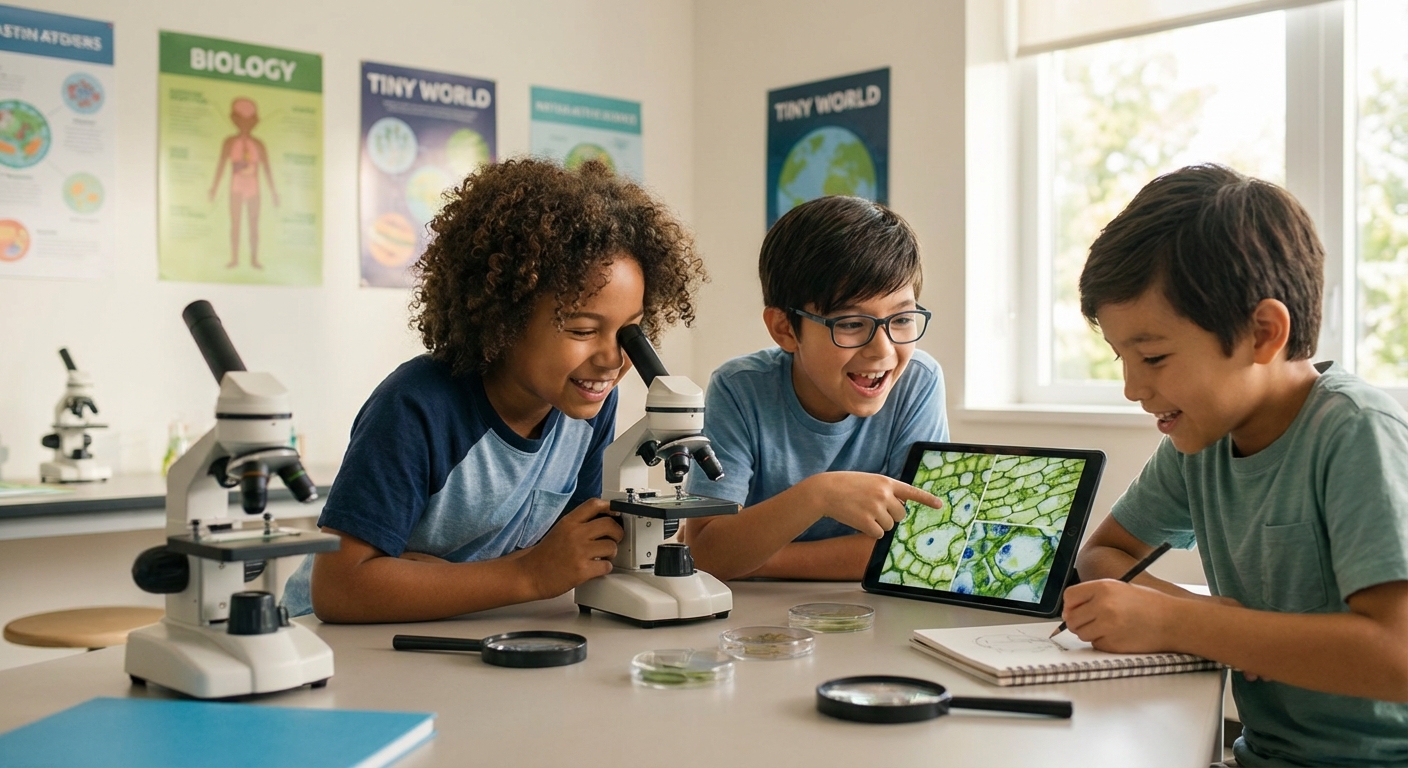
Discover the Tiny World: Microscopes!
What Is a Microscope?
A microscope is a tool that makes tiny things look big. Anything you can’t see with your eyes—like a grain of sand or a tiny bug—can be shown on a screen or a slide. Scientists use microscopes to learn how living things work, how plants grow, and to study very small materials.
How Does a Microscope Work?
Inside a microscope there are two main parts that help you see better:
- Lens – This glass piece bends (refracts) light so the picture looks larger.
- Stage – This flat platform holds the slide in place.
The microscope’s lenses bend light to form a magnified image, letting you see details that are normally too small to distinguish.
Types of Microscopes
There are several kinds, but the two most common for kids are:
| Type | What It Uses | What It Can Show |
|---|---|---|
| Light Microscope | Visible light (the same light we see everyday) | Cells, tiny insects, plant parts |
| Electron Microscope | Beams of electrons (much smaller than light) | Very tiny structures, even atoms |
The electron microscope can see far smaller things than the light microscope, but it is big and works in special labs.
Quick Quiz
-
What part of the microscope bends light to create a bigger image?
- A) Stage
- B) Lens
- C) Base
-
True or False: An electron microscope uses visible light.
- A) True
- B) False
-
Which type of microscope can let scientists see structures as small as atoms?
- A) Light microscope
- B) Electron microscope
- C) Handheld magnifying glass
Answers: 1️⃣ b, 2️⃣ b, 3️⃣ b
Conclusion
Now you know how microscopes turn the invisible into the amazing. Keep exploring, and you might discover something new tomorrow!