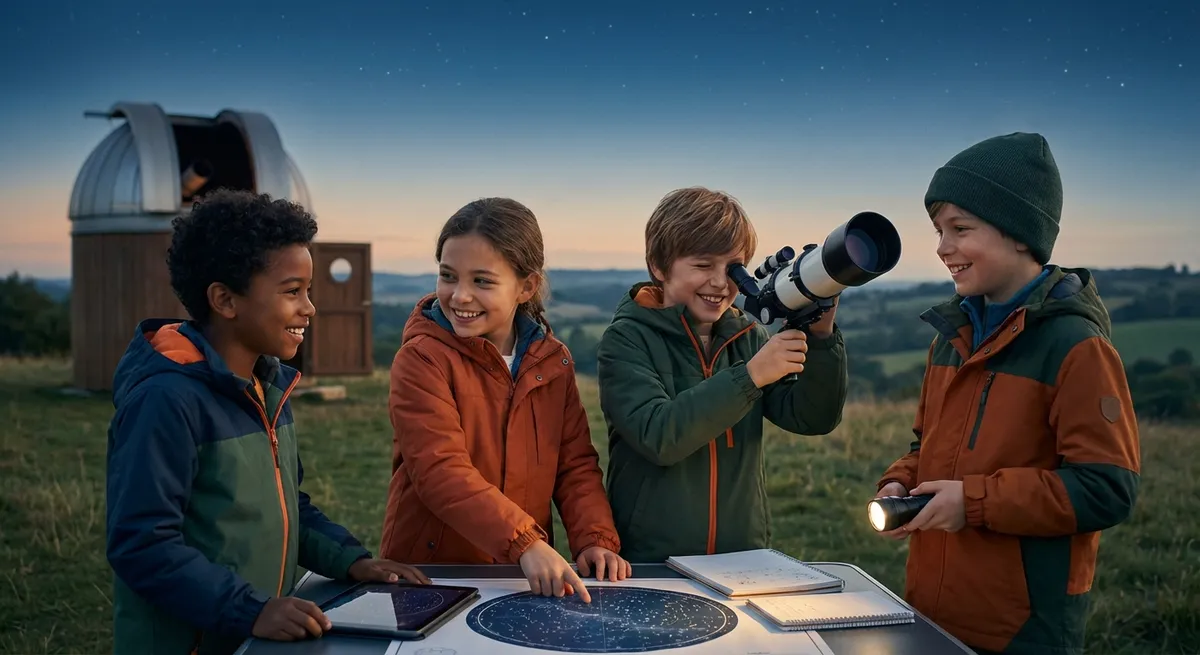
Discovering the Universe with Telescopes
Have you ever looked up at the night sky and wondered what those tiny specks of light really are? A Telescope is a special tool that helps us see far‑away objects—planets, stars, and even whole galaxies—much clearer than our eyes alone can. In this adventure, you’ll learn how telescopes work, the different kinds that exist, and even try a simple experiment at home!
1. How a Telescope Works
| Part | What It Does | Simple Definition |
|---|---|---|
| Lens | Bends (refracts) light to bring it to a focus. | A piece of clear glass or plastic that changes the direction of light. |
| Mirror | Reflects light to a focal point, just like a tiny, shiny road sign. | A smooth, curved metal surface that bounces light. |
| Aperture | The opening that lets light in; bigger = more light. | The “mouth” of the telescope. |
| Eyepiece | Magnifies the image formed by the lens or mirror. | The part you look through. |
Cause And Effect:
- Cause: A larger aperture lets more light enter.
- Effect: The image is brighter and you can see fainter objects, like distant galaxies.
When light from a far‑away star enters the telescope, the lens or mirror gathers the light and focuses it into a tiny point. The eyepiece then Magnifies (makes larger) that point so your eye can see details that would otherwise be invisible.
2. Types of Telescopes
-
Refracting Telescope – Uses only lenses.
Example: The classic “Galileo” telescope that first pointed at Jupiter. -
Reflecting Telescope – Uses a curved mirror instead of a lens.
Example: The huge Hale Bopp telescope at the Palomar Observatory. -
Catadioptric Telescope – Combines lenses And mirrors for a compact design.
Example: Many backyard “Newtonian” telescopes that fit in a small tube.
Did You Know?
🔹 The word refract comes from Latin “refringere,” meaning “to break up.” Light is “broken up” (bent) when it passes through a lens!
3. Famous Telescopes and What They Found
| Telescope | Where It Lives | Cool Discovery |
|---|---|---|
| Hubble Space Telescope | Orbiting Earth (above the atmosphere) | First clear pictures of distant galaxies and the “Pillars of Creation.” |
| James Webb Space Telescope (JWST) | L2 point, 1.5 million km from Earth | Saw the earliest galaxies that formed just 400 million years after the Big Bang. |
| Very Large Telescope (Vlt) | Chile’s Atacama Desert | Helped detect the first Earth‑like exoplanet orbiting a Sun‑like star. |
These giant instruments use Advanced Optics (the science of light) and Sensitive Detectors to capture faint signals that our eyes can’t see.
4. Mini Experiment: Build a Simple Telescope
You’ll Need:
- 2 magnifying glasses (one with a longer focal length, one with a shorter one)
- Cardboard tube (like a paper towel roll)
- Tape and scissors
Steps:
-
Insert The Long‑focal‑length Lens at one end of the tube. This will be the Objective Lens (the light‑gathering part).
-
Place The Short‑focal‑length Lens
-
Place The Short‑focal‑length Lens at the opposite end of the tube. This becomes the Eyepiece that magnifies the image.
-
Secure Both Lenses with tape so they stay in place.
-
Adjust The Tube Length by sliding the lenses slightly until the picture you see through the eyepiece is sharp.
-
Test Your Telescope on a distant object (a tree leaf, a sign, or the Moon). Notice how the image looks bigger and clearer!
Telescopes Quiz
Great job exploring telescopes! Keep looking up and discovering the wonders of the night sky.