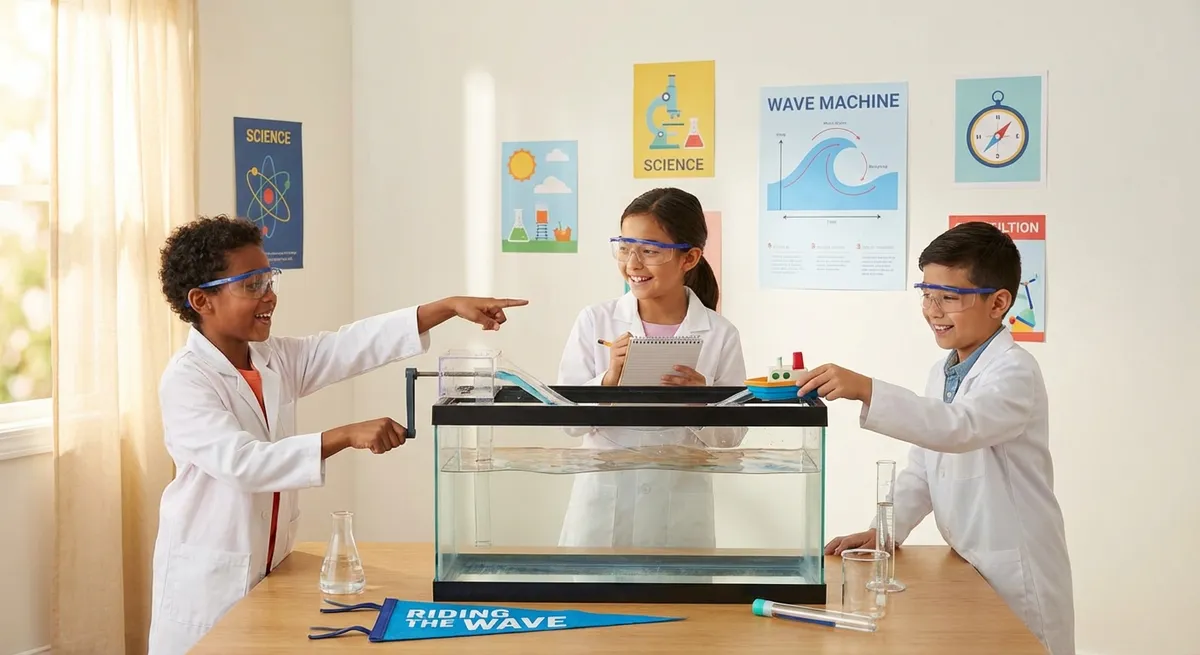
Riding the Wave: A Kid’s Guide to Waves in Science
Have you ever watched a stone splash into a pond and seen circles spreading out? Or felt the rumble of a drum beat? Those are Waves—energy that moves through water, air, or even solid objects. In this guide we’ll explore what waves are, how they work, and how you can see them in action right at home!
1. What Is a Wave?
A wave is a Disturbance (a little shake) that travels through a material, carrying energy from one place to another without moving the material itself. Think of a crowd doing “the wave” in a stadium: each person stands up and sits down, but the overall motion moves around the stadium.
Key Words
- Disturbance – a change that makes something move or vibrate.
- Energy – the ability to do work or cause change (like making a light turn on).
Types of Waves
| Type | Where it travels | Example |
|---|---|---|
| Water Waves | On the surface of water | Ripples in a pond |
| Sound Waves | Through air (and other gases) | Your voice traveling to a friend’s ear |
| Light Waves | Through empty space (vacuum) and transparent materials | Sunlight reaching Earth |
| Seismic Waves | Through the Earth’s crust | Earthquakes |
2. How Do Waves Move? – The Parts of a Wave
Every wave has two main parts:
- Crest – the highest point of the wave.
- Trough – the lowest point.
The distance from one crest to the next is called the Wavelength. The number of crests that pass a point each second is the Frequency.
Did You Know? The word frequency comes from the Latin frequentia, meaning “how often.”
Amplitude is another important word. It’s the height of the wave from the middle (called the Equilibrium Line) to the crest. Bigger amplitude = more energy (a louder sound or a higher splash).
3. Cause and Effect: Why Do Waves Form?
- Throwing A Stone → creates a disturbance → water particles move up and down → ripples spread outward.
- Plucking A Guitar String → the string vibrates → pushes air molecules → sound waves travel to your ears.
- Sunlight Hitting The Ocean → light waves bend (called Refraction) → you see the water sparkle.
Cause → Effect
| Cause | Effect (what you see/hear) |
|---|---|
| Wind blowing across the sea | Large, rolling Ocean Waves |
| Earthquake shaking the ground | Seismic Waves that can shake buildings |
| A flashlight turned on | Light Waves that let you see in the dark |
4. Mini Experiments You Can Try
Experiment: Make Your Own Ripple Tank
What You Need
- A shallow tray or baking dish
- Water
- A dropper or small spoon
- A flashlight (optional)
Steps
- Fill the tray about 1 cm deep with water.
- Place the tray on a flat surface and let the water settle.
- Gently drop a single drop of water from the dropper into the center.
- Watch the circles (waves) move outward.
Explore
- Move the flashlight to shine from the side. Do the waves look different when the light hits them at an angle? (That’s Refraction in action.)
- Try tapping the water with a finger instead of a drop. How does the Amplitude change?
What’s Happening? The drop creates a disturbance, sending energy outward as ripples. The water itself doesn’t travel far—only