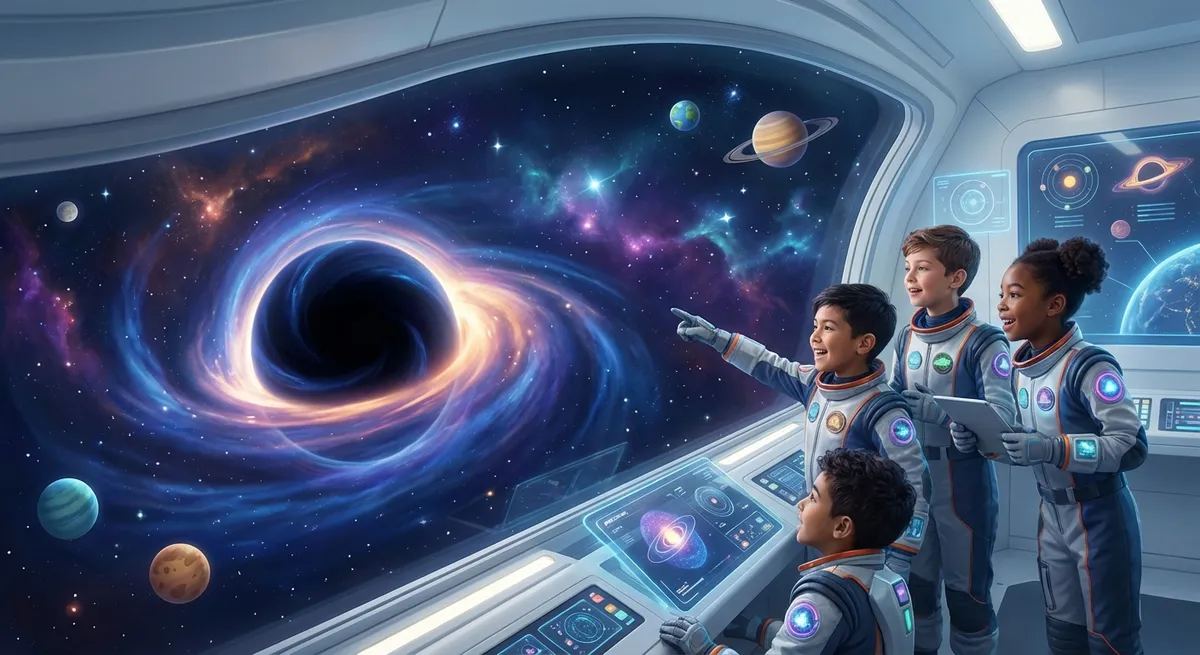
Black Holes: Space’s Greatest Mystery
Black holes are the most mysterious and powerful objects in the universe. They’re invisible, super heavy, and nothing can escape them - not even light!
What Is a Black Hole?
A black hole is a place in space where gravity is so strong that nothing can escape once it gets too close. Imagine a cosmic vacuum cleaner that’s millions of times stronger than anything on Earth!
How Black Holes Form
Most black holes form when massive stars die in spectacular explosions called supernovas:
- A Giant Star Runs Out Of Fuel - Stars 20 times bigger than our Sun
- The Star Collapses - In less than a second!
- Explosion! - A supernova blast brighter than a billion stars
- Black Hole Birth - The core becomes infinitely dense
If Earth became a black hole, it would be the size of a marble but have the same weight as our entire planet!
The Anatomy of a Black Hole
Event Horizon
This is the “point of no return” - the boundary around a black hole where escape becomes impossible. Once something crosses the event horizon, it’s gone forever!
Singularity
At the center of a black hole is the singularity - a point where all the matter is crushed into zero space. The laws of physics as we know them break down here.
Accretion Disk
Hot gas and dust spiral around the black hole like water going down a drain, glowing brilliantly from friction.
🔬 Try This: Black Hole Simulation
- A stretchy fabric or sheet
- A heavy ball (bowling ball works great)
- Marbles
- Stretch the fabric tight between people or furniture
- Place the heavy ball in the center (this is your “black hole”)
- Roll marbles near it and watch them spiral inward
- Notice how closer marbles can’t escape!
Mind-Blowing Black Hole Facts
- Time Moves Differently - Near a black hole, time slows down compared to the rest of the universe
- Supermassive Giants - The biggest black holes are billions of times heavier than our Sun
- They’re Everywhere - Scientists estimate 100 million black holes in our galaxy alone
- We Photographed One - In 2019, scientists took the first ever picture of a black hole’s event horizon
Black Holes in Our Galaxy
At the center of our Milky Way galaxy sits a supermassive black hole called Sagittarius A*. It’s 4 million times heavier than our Sun! Don’t worry though - it’s 26,000 light-years away, so we’re perfectly safe.
Black holes remind us that the universe still holds incredible mysteries waiting to be discovered. Maybe one day, you’ll help solve them!