Eclipses: Shadows In Space
Have you ever seen the Sun disappear for a few minutes, or the Moon turn a spooky shade of orange? Those are Eclipses—special events when one celestial body (the Sun, Moon, or Earth) blocks the light of another. In this guide you’ll learn how eclipses happen, why they’re different, and even try a simple experiment at home!
1. What Is an Eclipse?
- Solar Eclipse – The Moon moves directly between the Earth and the Sun, casting a shadow on parts of our planet.
- Lunar Eclipse – The Earth comes between the Sun and the Moon, and Earth’s shadow falls on the Moon.
Both types are caused by Alignment—the three bodies line up in a straight (or nearly straight) line called Syzygy.
Vocabulary Boost
Alignment – objects placed in a straight line.
Syzygy – a fancy word for that straight‑line arrangement in space.
2. Why Do Eclipses Look Different?
Solar Eclipse
- Total – The Moon completely covers the Sun. Day turns to night for a few minutes!
- Partial – Only part of the Sun is hidden.
- Annular – The Moon is a little farther away, so a bright “ring of fire” (the Sun’s outer edge) stays visible.
Lunar Eclipse
- Total – The whole Moon goes through Earth’s shadow and can turn a coppery red.
- Partial – Only a slice of the Moon is in the shadow.
- Penumbral – The Moon passes through the faint outer part of Earth’s shadow, so the dimming is subtle.
Cause And Effect:
- The Moon’s orbit is tilted about 5° relative to Earth’s orbit. That’s why eclipses don’t happen every month—most of the time the Moon passes Above or Below Earth’s shadow.
3. Did You Know?
- The word Eclipse comes from the ancient Greek ekleipsis, meaning “to fail to appear.”
- During a total solar eclipse, animals can become confused—birds may stop singing, and crickets start chirping as if night has arrived.
- The red color of a total lunar eclipse is caused by Rayleigh Scattering (the same reason our sky is blue). Sunlight bends through Earth’s atmosphere, drops the blue light, and the remaining red light paints the Moon.
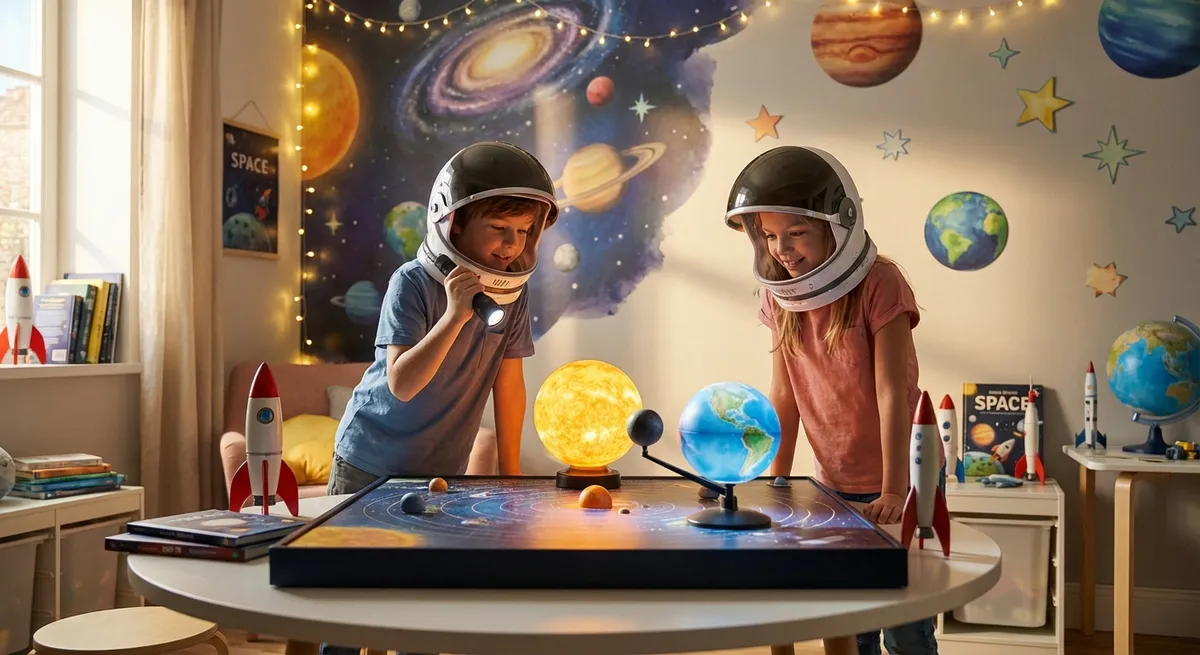
4. Mini Experiment: Make Your Own Eclipse!
What You Need
- A bright lamp (the “Sun”)
- A small ball (the “Moon”) – a tennis ball works well
- A larger ball (the “Earth”) – a beach ball or orange
- A dark room
Steps
- Dim the lights and place the lamp on a table.
- Hold the small ball between the lamp and a piece of white paper on the floor—this shows a Mini Solar Eclipse. Notice the tiny shadow!
- Now place the large ball between the lamp and the small ball. The small ball’s surface will darken—this mimics a Lunar Eclipse.
- Move the balls around and watch how the shadows change.
What’s Happening?
- The lamp’s light represents the Sun’s rays.
- The balls block those rays, creating shadows just like Earth and the Moon do in space.
5. Quick Quiz
| # | Question | Answer |
|---|---|---|
| 1 | Which body casts the shadow during a Lunar eclipse? | Earth |
| 2 | What do we call the bright ring seen in an Annular solar eclipse? | “Ring of fire” |
| 3 | True or False: Eclipses happen every month. | False |
| 4 | What causes the Moon to look red during a total lunar eclipse? | Red sunlight refracted through Earth’s atmosphere |
Conclusion – Keep Looking Up!
Eclipses remind us that the Sun, Moon, and Earth are dancing in a grand cosmic choreography. The next time
you see an eclipse, remember the shadows and the science behind them, and maybe try the mini experiment with friends! Happy stargazing!