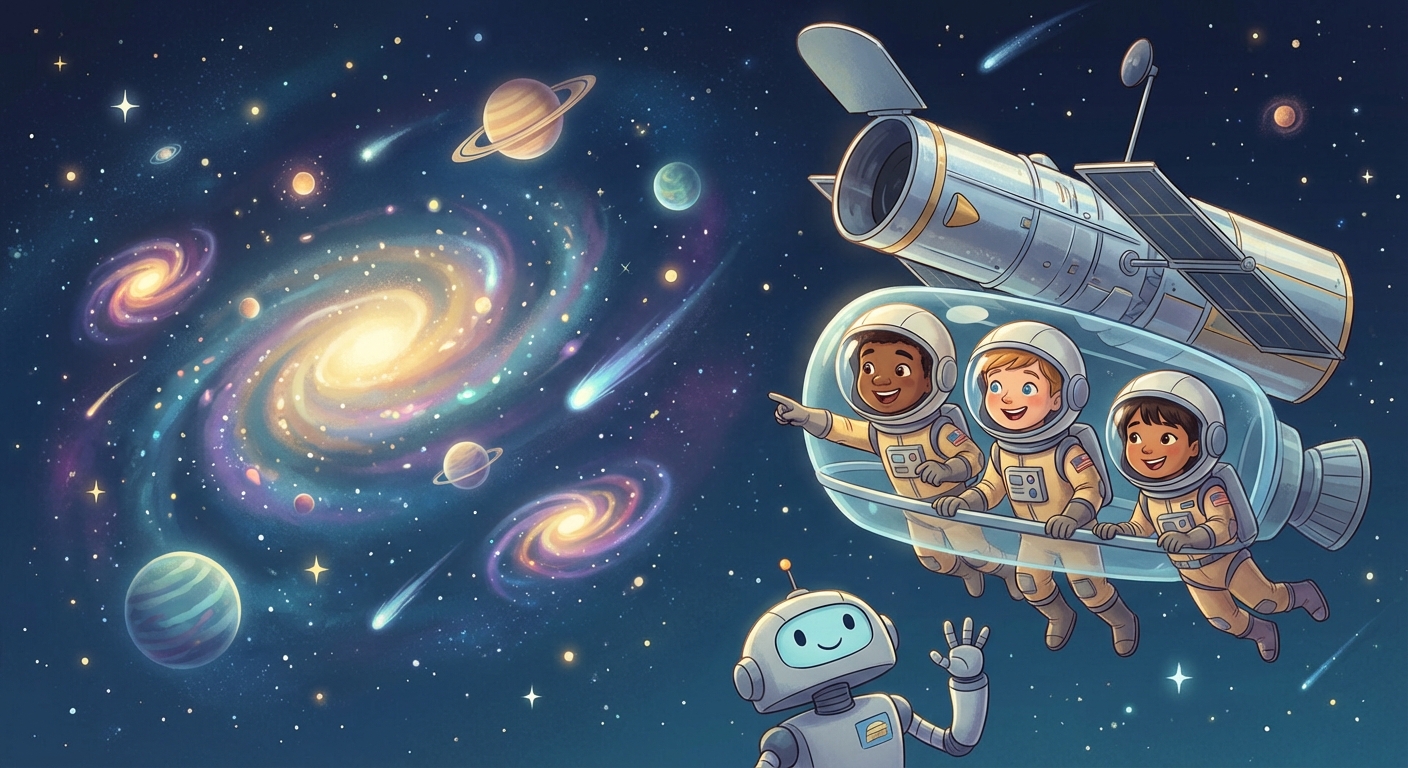
The Hubble Space Telescope: Our Cosmic Window
The Hubble Space Telescope (HST) launched in 1990 and orbits Earth above almost all of the atmosphere. Its observations help scientists study planets, stars, nebulae, galaxies, and the changing universe.
1. How Hubble Works – A Giant Camera in Space
- Orbit: Hubble circles Earth several hundred kilometers above the surface. Its exact altitude changes gradually over time.
- Mirrors And Instruments: A 2.4-meter primary mirror gathers light. Other optics direct it to scientific instruments with detectors.
- Cause & Effect: Above almost all of the atmosphere, Hubble avoids atmospheric turbulence and can observe some ultraviolet light that the atmosphere blocks. Ground observatories still have important advantages, including much larger mirrors and instruments that can be repaired or replaced more easily.
Did You Know? Hubble can collect light for long exposures, allowing its instruments to record objects far too faint for unaided human eyes. The exact comparison depends on the object, filter, and exposure.
2. What Hubble Has Discovered
| Discovery | Why It’s Important | Example |
|---|---|---|
| Expansion Measurements | Hubble observations help scientists refine measurements of how quickly the universe expands. | Distances to certain stars and supernovae |
| Accelerating Expansion | Hubble observations contributed evidence and follow-up studies of the universe’s accelerating expansion. | Measurements of distant supernovae |
| Planet-forming Disks | Images of disks around young stars help scientists study environments where planets may form. | Proplyds in the Orion Nebula |
These findings help us answer big questions: How did the universe begin? What is out there?
3. Hubble’s Amazing Pictures – A Gallery of Wonders
- The Andromeda Galaxy – Our nearest large galaxy, seen in stunning detail.
- The Sombrero Galaxy – Looks like a cosmic hat because of a bright dust lane.
- The Hubble Deep Field – A tiny patch of sky that revealed thousands of invisible galaxies!
Vocabulary Boost
- Galaxy – A massive collection of stars, gas, and dust held together by gravity.
- Nebula – A cloud of gas and dust in space. Some are places where stars form; others are produced by dying stars or supernova explosions.
- Spectroscopy – A technique that spreads light into a rainbow to tell what elements are present (think of a prism).
4. Mini Activity: Trace a Telescope’s Light Path
This paper model shows why a curved mirror can bring incoming light toward a focus. It is a diagram, not a working telescope.
Materials
- Paper
- Pencil
- Ruler
- A round bowl or plate for tracing a curved line
Steps
- Trace a short inward-curving arc to represent a simplified concave mirror.
- Use the ruler to draw three parallel arrows traveling toward the mirror.
- After each arrow reaches the mirror, draw a reflected line heading toward one shared point in front of the mirror. Label this point focus.
- Remember that real telescope optics require precise curved surfaces and more detailed geometry. Never look at the Sun through any telescope, lens, mirror, or optical device.
Observation: A telescope’s mirror gathers light across a large area and directs it toward instruments. Hubble’s actual two-mirror design is more complex than this drawing.
Hubble Telescope Quiz
Keep Exploring
Pick a Hubble image and tell a friend the first question it sparks. Writing those questions down is how new space mysteries begin.