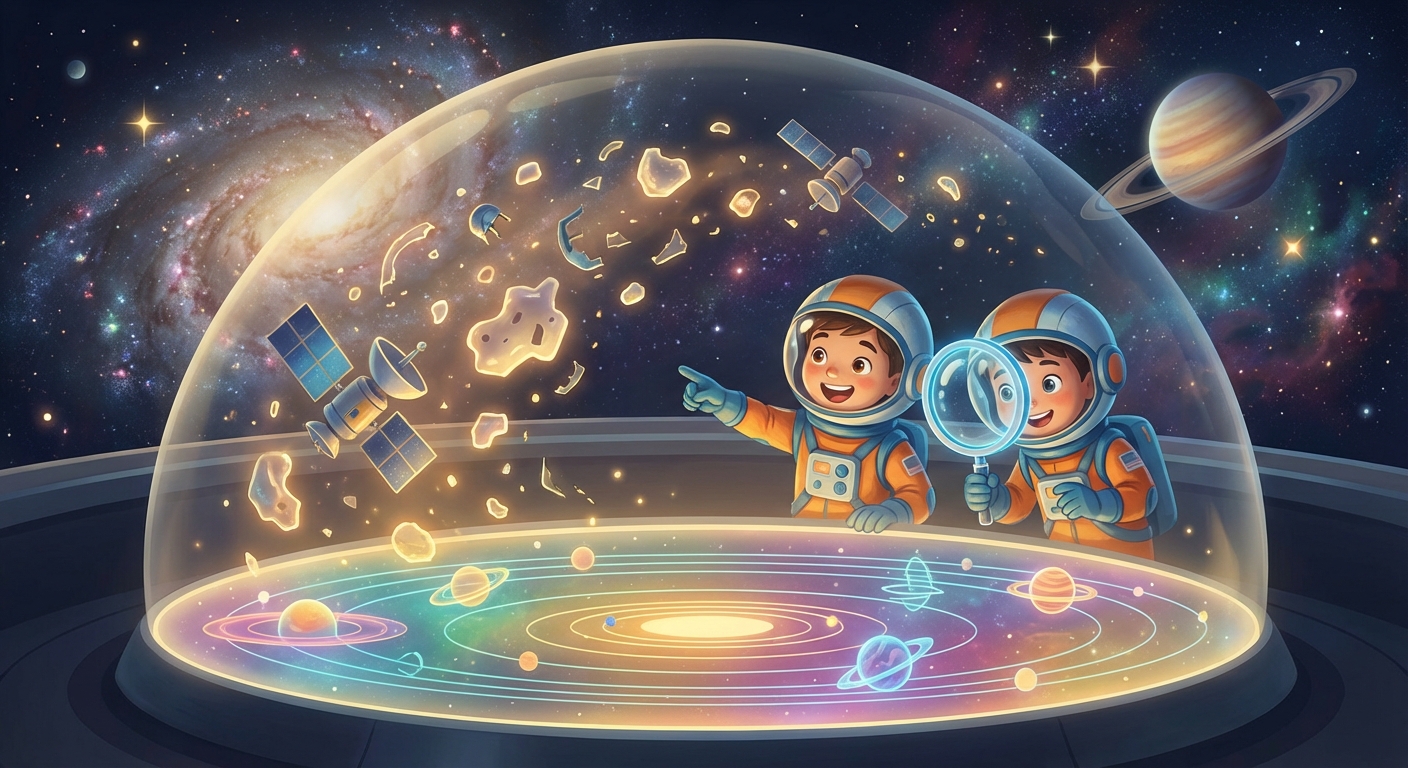
The Mystery of Space Debris
When you look up at the night sky you see twinkling stars, the glowing Moon, and maybe a bright satellite streaking by. But far above Earth, there’s another, invisible crowd moving around us: Space Debris. These are bits of metal, plastic, and old equipment that no longer work but still zoom around the planet at incredible speeds. Let’s explore what space debris is, why it matters, and what we can do to keep space safe for future explorers!
1. What Is Space Debris?
Space Debris (also called orbital junk) includes:
| Item | Where It Comes From | Why It’s a Problem |
|---|---|---|
| Defunct satellites | Old communication or weather satellites that have run out of fuel | They can smash into active satellites. |
| Rocket stages | Parts of rockets that fall away after launch | They stay in orbit for years. |
| Tiny fragments | Pieces broken off during collisions or explosions | Even a grain of sand can damage a spacecraft at 17,500 mph! |
Vocabulary Boost
- Orbital – moving around a planet in a regular path called an orbit.
- Trajectory – the path an object follows through space.
- Fragmentation – breaking into many small pieces, like a shattered glass.
2. How Does Space Debris Form? – Cause and Effect
- Launches: Every time a rocket lifts off, parts are left behind.
- Collisions: When two objects bump into each other, they shatter, creating many new pieces.
- Explosions: Leftover fuel can explode, spraying debris in all directions.
Effect: More debris means a higher chance that a new satellite or even a future space mission could be hit. A single collision can create a chain reaction called the Kessler Syndrome, where debris multiplies rapidly and makes certain orbits unsafe.
3. Real‑world Examples
- The 2009 Iridium‑33 / Cosmos‑2251 Crash: Two defunct satellites collided over Siberia, producing over 2,000 trackable pieces.
- The “Space Fence” Radar: Scientists use giant radar dishes to watch debris as small as a baseball, helping us avoid dangerous encounters.
Did You Know? The International Space Station (ISS) has to perform debris avoidance maneuvers—tiny thruster burns—to dodge pieces that come too close. 🌍
4. What Can We Do? Mini Experiments & Everyday Actions
Experiment: “orbit in a Bottle”
Materials: A clear plastic bottle, water, a small piece of foil, a flashlight.
- Fill the bottle half‑full of water (the “Earth”).
- Place the foil piece on the surface (the “satellite”).
- Shine the flashlight from the side to simulate the Sun’s light.
- Gently swirl the bottle and watch the foil spin—just like an object orbiting Earth.
What To Observe:
- The foil stays in motion unless it hits the bottle wall (like debris hitting a satellite).
- Adding tiny bits of paper (debris) shows how they can collide and change the foil’s path.
Everyday Hero Tip
When you watch a rocket launch on TV, remember that engineers are already planning to de‑orbit (bring down) the rocket’s empty stages safely, either by burning them up in the atmosphere or steering them to a remote ocean spot.
Quick Quiz
- True Or False: A tiny piece of debris can damage a spacecraft because of its high speed.
- What Does “Orbital” Mean?
- Name One Way Scientists Track Space Debris.
(Answers: 1 True, 2 Moving around a planet in an orbit, 3 Radar or telescopes.)
Conclusion – Keep Looking Up!
Space
is a shared playground, and we all have a role in keeping it clean. By learning about space debris and supporting smart solutions, we help protect the sky for future explorers and scientists. Keep looking up, stay curious, and remember: even small actions on Earth can make a big difference for the stars above. Together, we can keep space safe and sparkling!