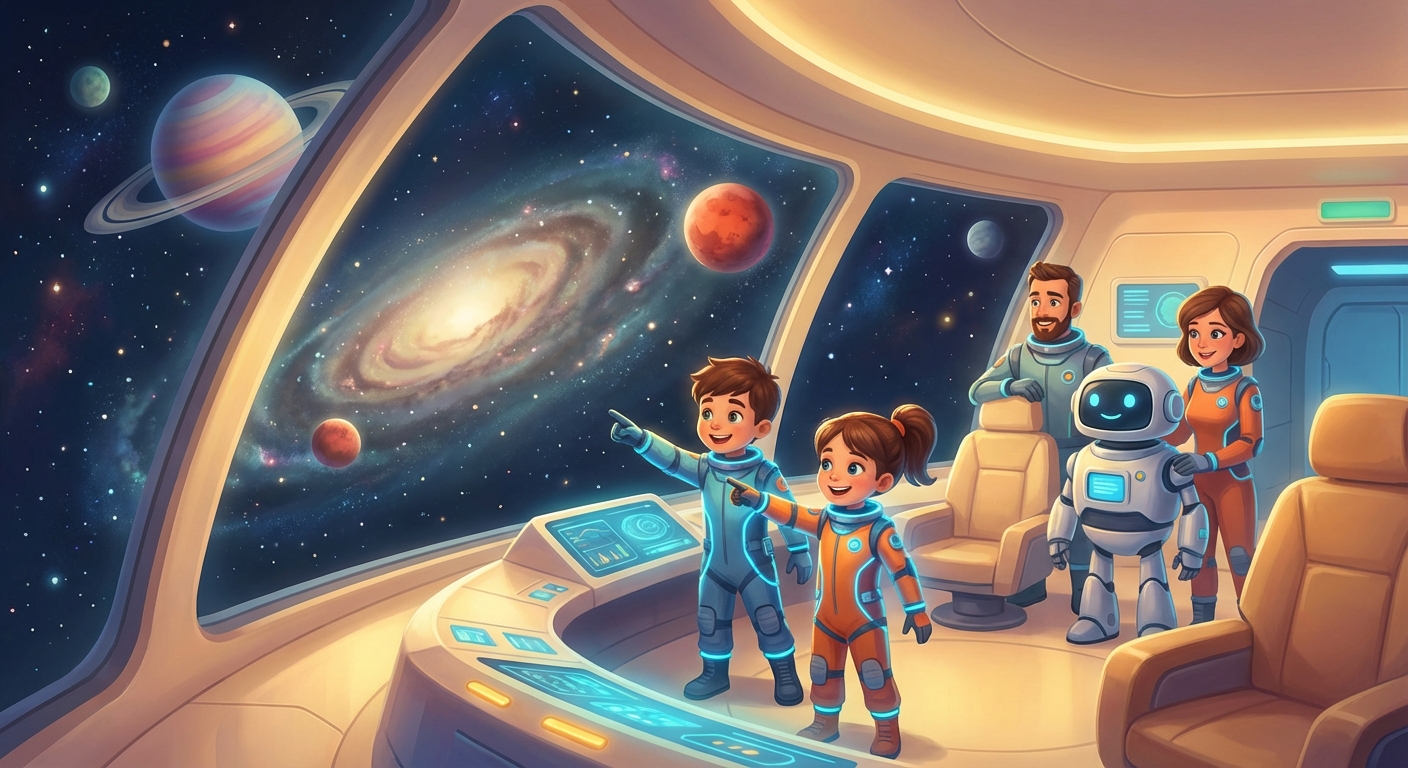
Space Tourism: Vacationing Among the Stars
Imagine looking out the window of a spaceship and seeing Earth as a tiny blue marble. That’s the dream of Space Tourism – traveling to space for fun, learning, and adventure. In this guide we’ll explore how space tourism works, why it’s becoming possible, and what you can try at home to feel like an astronaut!
1. How Do People Get to Space?
The Journey
- Launch – A rocket blasts off, pushing the spacecraft upward against Earth’s gravity.
- Orbit – Once high enough, the craft circles the planet in a path called an orbit.
- Re‑entry – The spacecraft slows down and falls back, heating up as it slides through the atmosphere before landing safely.
Cause And Effect: The rocket’s powerful engines (cause) create enough thrust to overcome gravity, allowing the spacecraft to reach orbit (effect).
New Vehicles for Tourists
- Sub‑orbital Rockets (like Blue Origin’s New Shepard) give a few minutes of weightlessness before coming back down.
- Orbital Habitats (such as Axiom Space’s planned station) let travelers stay in space for days or weeks.
Vocabulary:
- Thrust – the force that pushes a rocket upward.
- Microgravity – the feeling of almost no weight you experience while orbiting Earth.
2. Why Is Space Tourism Growing?
Technological Advances
- Reusable Rockets can land and be used again, lowering the cost of each trip.
- Better Life‑support Systems keep travelers safe by providing oxygen and controlling temperature.
Economic Effects
- More tourists mean more money for research, which can fund new Scientific Experiments that benefit everyone on Earth.
Cause And Effect: Reusable rockets (cause) reduce launch costs (effect), making trips affordable for more people.
Environmental Considerations
Space travel releases some greenhouse gases, so engineers are working on Cleaner Propellants to protect our planet.
3. What Can You Experience in Space?
- Weightlessness: Float like a feather, spin a ball, or drink a floating sip of water!
- Earthrise: Watch sunrise and sunset every 90 minutes as you orbit the planet.
- Stunning Views: See continents, oceans, and the thin blue line of the atmosphere.
Did You Know? Astronauts can see up to 16 sunrises and sunsets in a single 24‑hour day while circling Earth! 🌅
4. Mini Experiment: “balloon Rocket” –
Materials
- A long drinking straw
- Thin string or fishing line (about 3 m)
- A balloon
- Tape
- Scissors
Steps
- Thread the string through the straw and tie the ends of the string to two sturdy points (like chairs) so the line is tight and horizontal.
- Inflate the balloon but do Not tie it; pinch the opening to keep the air inside.
- Tape the balloon to the middle of the straw, making sure the opening points toward the back of the straw.
- Let go of the balloon’s opening. The air rushes out, pushing the straw‑balloon along the string—just like a tiny rocket!
What You Learn
- The escaping air creates Thrust, the same idea that pushes real rockets upward.
- The faster the air leaves, the faster the “rocket” moves.
- You can experiment with balloon size or how much you inflate it to see how the speed changes.
Quiz
-
What force pushes a rocket (or balloon) forward?
a) Gravity
b) Thrust ✓
c) Friction
d) Magnetism -
Why do reusable rockets make space travel cheaper?
a) They use less fuel
b) They can be flown again ✓
c) They are smaller
d) They travel slower -
What do astronauts feel when they are in orbit?
a) Heavy weight
b) Microgravity ✓
c) Strong wind
d) Loud noises
Now you’re ready to dream of your own space adventure!