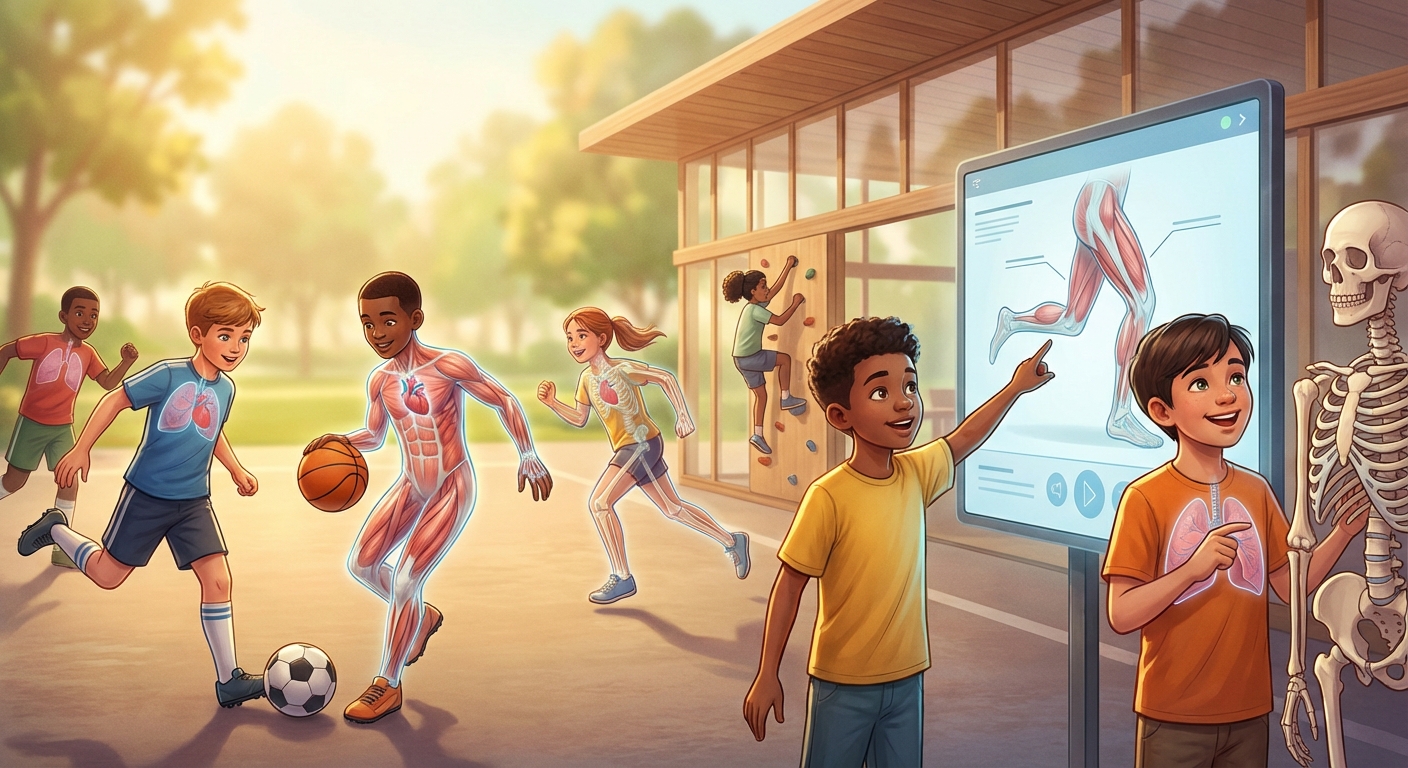
♂️ Anatomy for Athletes: How Your Body Powers Play
Every time you run, jump, or throw a ball, a team of body parts works together like a well‑practiced sports crew. Understanding the Anatomy (the study of body parts) behind those moves can help you play safer, stronger, and smarter. Let’s explore the muscles, bones, and lungs that turn ordinary kids into everyday athletes!
1. Muscles – The Body’s Engines
What They Do: Muscles contract (shorten) to move your bones, giving you power for sprints, kicks, and swings.
Key Players:
- Quadriceps – the front thigh muscles that straighten your leg when you kick a soccer ball.
- Hamstrings – the back‑of‑the‑thigh muscles that bend the knee and help you sprint.
- Deltoids – shoulder muscles that lift your arms for a basketball shot.
Cause & Effect:
- Strong Muscles → Faster Speed – When your quadriceps get stronger, you can push off the ground harder, which means you run faster.
- Weak Muscles → Higher Injury Risk – If your hamstrings are weak, they can’t slow your leg down quickly, increasing the chance of a strain.
Did You Know? The word muscle comes from the Latin musculus, meaning “little mouse,” because the way a flexed muscle looks a bit like a tiny mouse under the skin!
2. Bones – The Rigid Framework
What They Do: Bones give your body shape, protect vital organs, and act as levers for muscles to pull on.
Important Bones For Athletes:
- Femur – the longest bone in your body; it supports the weight when you run or jump.
- Scapula (shoulder blade) – helps move your arms in many directions.
- Vertebrae – the stack of bones in your spine that keeps you upright and absorbs shock.
Cause & Effect:
- Strong Bones → Better Endurance – Calcium‑rich foods help bones stay dense, so they can handle the repeated impact of running laps.
- Brittle Bones → Easy Fractures – Not getting enough calcium or vitamin D can make bones fragile, leading to breaks during a fall.
Mini Fact: Children’s bones differ in size and shape depending on the bone and stage of growth; there is no single “one-third” rule. Growth plates near the ends of many long bones are areas where new bone forms as a child grows.
3. Lungs & Heart – The Power Plants
What They Do: Your lungs bring oxygen into the blood, and your heart pumps that oxygen‑rich blood to muscles.
How It Works While You Play:
- You inhale → lungs fill with oxygen.
- Oxygen travels to the heart → heart beats faster, pushing blood to muscles.
- Muscles use oxygen to create energy, letting you keep moving.
Cause & Effect:
- Regular Cardio (Running, Swimming) → Bigger Heart – A stronger heart can pump more blood per beat, so you don’t get tired as quickly.
- Skipping Breathing Exercises → Poor Stamina – If you don’t practice deep breaths, you might feel “out of breath” sooner.
Did You Know? The average adult heart beats about 100,000 times a day—imagine that many “high‑fives” for your body!
4. Nerves – The Fast Messengers
What They Do: Nerves send signals from your brain to muscles, telling them when and how to move.
Quick Example: When you see a ball flying toward you, visual nerves tell your brain, which then sends a rapid signal through the motor nerves to your arm muscles to catch it—sometimes in just 0.2 seconds!