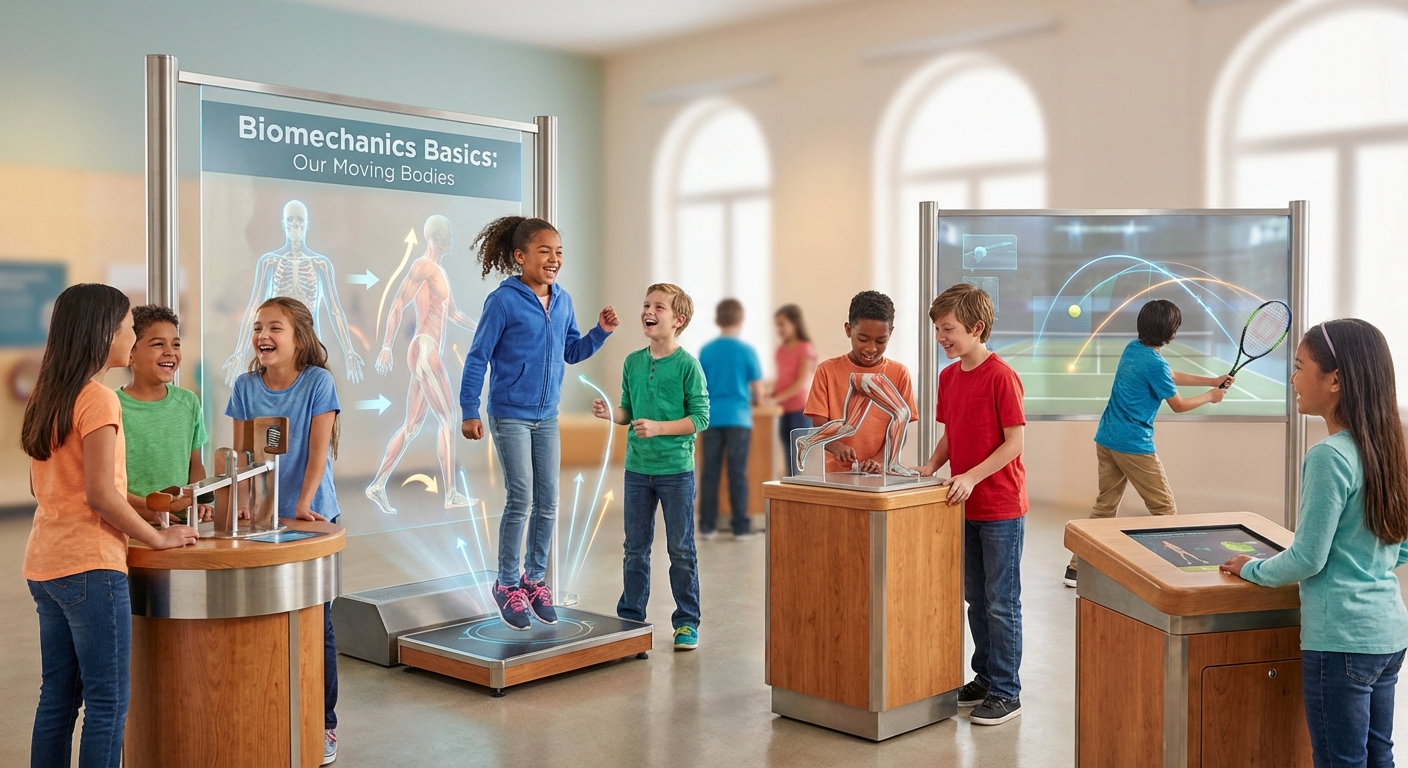
Biomechanics Basics: How Our Bodies Turn Moves into Sports Magic
Ever wonder why a soccer player can kick a ball far, or how a gymnast spins so smoothly? The secret lies in Biomechanics – the science of how our bodies move. In this adventure we’ll explore the forces, levers, and tricks that turn everyday motions into amazing sports feats!
1. Forces and Motion – The Push‑pull Power
When you throw a basketball, you are applying a Force (a push or pull). The ball then accelerates (speeds up) because of that force.
- Cause → Effect:
- Cause: You bend your knees and swing your arm.
- Effect: The ball flies higher and farther.
Key Vocabulary
- Force – a push or pull that can change how something moves.
- Acceleration – how quickly something speeds up or slows down.
Did You Know? A 10‑year‑old can generate significant force when jumping, helping them leap higher!
2. Levers – Your Body’s Built‑in Tools
Your bones act like Levers (simple machines that help lift or move things). Each lever has three parts: the Fulcrum (the joint), the Effort (muscle force), and the Load (what you’re moving).
| Lever Type | Example in Sports | How It Helps |
|---|---|---|
| First‑class (fulcrum in the middle) | See‑saw, neck tilting | Balances the head on the spine. |
| Second‑class (load in the middle) | Standing on tiptoes, calf raise | Makes it easy to lift your body. |
| Third‑class (effort in the middle) | Throwing a baseball, kicking a soccer ball | Gives you speed and range. |
Mini Experiment:
- Place a ruler on a pencil (the pencil is the fulcrum).
- Put a small weight (like a paperclip) on one end and press down on the other.
- Notice how the ruler lifts the weight—just like your leg lifts a ball!
3. Kinetic Energy – The Motion Money
When you run, jump, or swing, your moving body has kinetic energy. The faster an object of the same mass moves, the more kinetic energy it has. Elastic materials can temporarily store elastic potential energy when they bend, stretch, or compress.
- Example: A shoe’s springy material can deform when the foot lands and return some elastic potential energy as it regains its shape. Muscles and tendons supply most of the athlete’s motion.
Key Vocabulary
- Kinetic – relating to motion.
- Energy Transfer – moving energy from one object to another (like from your leg to a soccer ball).
Cause → Effect:
- Cause: A tennis racket’s strings stretch when they hit the ball.
- Effect: The strings return some stored elastic potential energy as they spring back and the ball leaves the racket.
4. Balance and Equilibrium – Staying Steady
Equilibrium means staying balanced. In sports, athletes constantly adjust their center of mass (the point where their weight is evenly spread) to stay upright.
- Example: A skateboarder bends their knees and leans slightly forward to keep from falling when cruising.
Did You Know? Gymnasts train to control their balance on a competition beam that is only 10 cm (about 4 inches) wide.
Mini Quiz & Experiment
Quiz (circle the Answer)
-
Which part of a lever is the joint?
a) Fulcrum b) Load c) Effort -
What does “kinetic” mean?
a) Still b) Moving c) Heavy -
When you bend your knees before jumping, you are:
a) Reducing force
b) Storing energy
c) Increasing air resistance
d) Losing balance