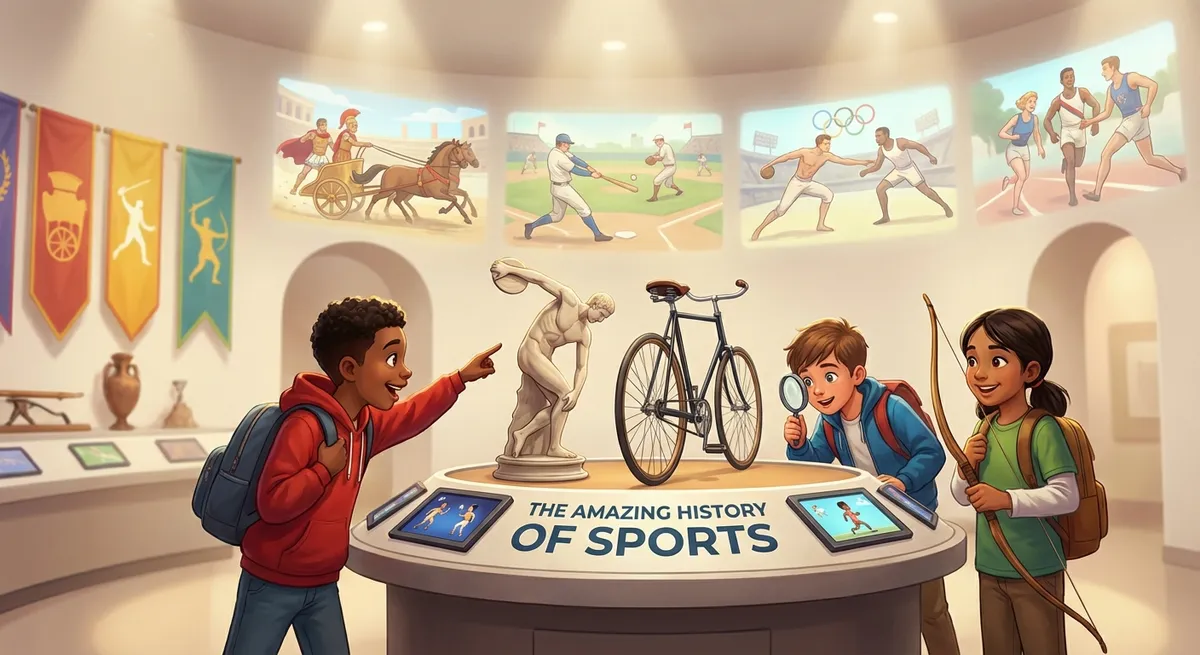
The Amazing History of Sports
Sports are more than just fun games—they’re a window into the past! By looking at how games started, changed, and spread around the world, we can see how people used Creativity, Competition, and Science to stay healthy and entertained. Let’s travel through time and discover the story behind the sports we love today.
1. The First Games: Ancient Beginnings
What Happened?
Around 2,776 Bce (that’s over 4,800 years ago), the ancient Greeks held the first Olympic Games in a city called Olympia. Only men could compete, and the events were simple: running, wrestling, and throwing a heavy stone called a Discus.
Why Did They Start?
The Greeks believed that exercising the body helped the Mind (the part of you that thinks and learns). They also thought good athletes could honor the gods.
Cause and Effect
Cause: A religious festival for the god Zeus.
Effect: A tradition that lasted for almost 12 centuries and inspired modern Olympics.
Vocabulary Boost
- Ancient – very, very old.
- Discus – a heavy, flat disc thrown for distance (like a giant frisbee).
Did You Know? The original Olympic stadium could hold only about 45,000 spectators—today’s stadiums can hold over 100,000 people!
2. From Castles to Courts: Medieval & Early Modern Sports
What Happened?
During the Middle Ages (500‑1500 CE), knights practiced Jousting on horseback to prepare for battle. In England, children played Mob Football, a chaotic game with no set rules—think of it as a giant, noisy version of soccer.
Why Did They Change?
As societies became Urban (more people living in cities) and Peaceful, people needed games that fit smaller spaces and didn’t require armor. This led to the birth of Tennis, Golf, and Cricket.
Cause and Effect
Cause: The rise of towns and the decline of constant warfare.
Effect: New sports that emphasized skill, strategy, and teamwork instead of just strength.
Vocabulary Boost
- Jousting – a competition where two riders try to knock each other off their horses with a lance.
- Urban – relating to a city or town.
Did You Know? The first recorded game of tennis was played in 12th‑century France, but it was played with the hand, not a racket!
3. Modern Olympics and Technology
What Happened?
The modern Olympic Games were revived in 1896 by a Frenchman named Pierre De Coubertin. Since then, the Olympics have added Track And Field, Swimming, Basketball, and even Snowboarding!
Why Does Technology Matter?
Advances in Physiology (the study of how bodies work) and Materials Science have made sports faster and safer. For example, running shoes now have Cushioning Foam that reduces impact, and swimsuits are made of slick, water‑repellent fabrics.
Cause and Effect
Cause: Invention of lighter, stronger materials and better understanding of the human body.
Effect: Athletes can break records that seemed impossible a few decades ago.
Vocabulary Boost
- Physiology – the science of how living things function.
- Materials Science – the study of how different substances (like plastic or metal) behave and