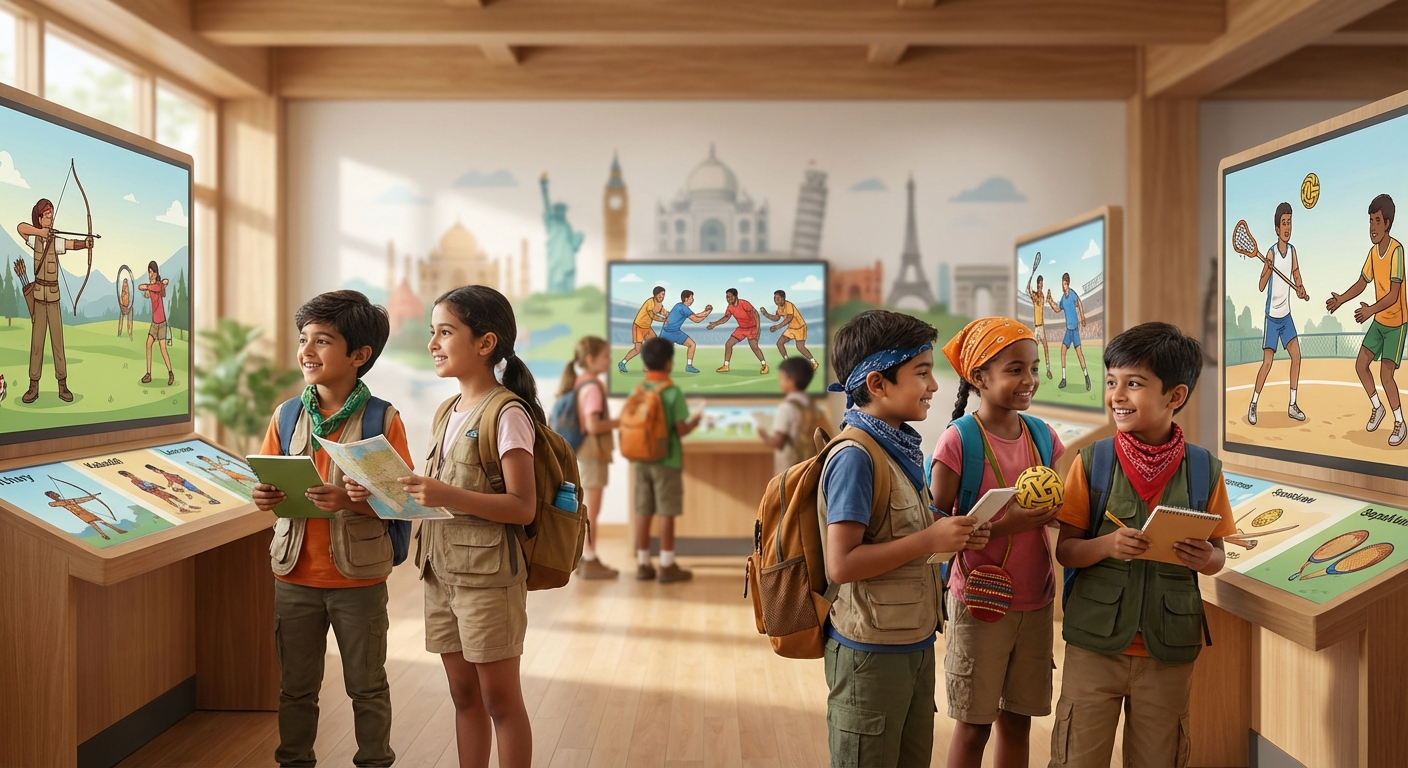
Traditional Sports Around the World
Sports aren’t just games – they are a window into the history, culture, and even the science of a place. From the icy fields of Finland to the dusty deserts of Morocco, traditional sports show how people use Physics (the study of motion and forces) and Biology (the study of living bodies) to have fun, stay healthy, and celebrate their heritage. Let’s travel the globe and discover a few of these fascinating games!
1. Kabaddi – India & Bangladesh
What Is It?
Kabaddi is a fast‑paced tag game played on a rectangular court. One “raider” runs into the opposing team’s half, tries to tag as many players as possible, and then rushes back while repeatedly chanting “kabaddi, kabaddi!”
Science Behind The Game
- Respiration: Depending on the version and rules, a raider may repeat a chant during one breath. This involves breath control, but lungs do not simply act as storage tanks.
- Momentum: A moving raider has momentum based on mass and velocity. Balance, grip, timing, direction, and the rules also affect what happens during contact.
Did You Know?
Kabaddi has several regional forms and a long history in South Asia. Explanations of the name’s exact origin vary, so it is better not to present one disputed etymology as certain.
2. Sumo Wrestling – Japan
What Is It?
Sumo is a traditional Japanese sport where two wrestlers (rikishi) try to push each other out of a circular ring or make any part of the opponent’s body touch the ground.
Science Behind The Sport
- Center Of Gravity: A wrestler’s balance depends on keeping their center of gravity low. The lower it is, the harder it is to be toppled.
- Force & Friction: The massive weight of the wrestlers creates huge forces, but the ring’s clay surface provides friction that helps them grip the ground.
Did You Know?
Chankonabe is a hot-pot dish associated with sumo stables, but it has no special weight-gain ingredient. Wrestlers’ body size reflects total diet, training, rest, and individual biology. Children should not copy an elite athlete’s eating regimen.
3. Capoeira – Brazil
What Is It?
Capoeira blends martial arts, dance, and music. Players form a circle (the roda) and take turns performing acrobatic kicks, spins, and flips while a drum beats.
Science Behind The Art
- Kinematics: The spins and jumps illustrate the study of motion, showing how angular velocity (how fast something rotates) changes with body position.
- Rhythm & Movement: Music helps shape the pace and flow of the game. Physical activity also raises heart rate.
Did You Know?
Capoeira developed among Africans and their descendants in Brazil under slavery and afterward. It combines fighting techniques, music, movement, community, and cultural resistance; historians caution against reducing its complex history to a single origin story.
4. Gaelic Football – Ireland
What Is It?
Gaelic football is a distinct Irish field sport. Players can kick, hand-pass, or carry the ball under its rules, aiming to score over the crossbar for one point or into the goal for three points.
Science Behind The Game
- Aerodynamics: The shape of the ball and the way it’s kicked affect its flight path, showing how air resistance and lift work.
- Energy Transfer: When a player jumps to catch the ball, potential energy (energy stored due to height) turns into kinetic energy (energy of motion) as they land.
Did You Know?
The sport is governed by the Gaelic Athletic Association (GAA), which also promotes Irish language and music—linking sports with Sociology (the study of societies).
Mini Experiment: “build Your Own Mini‑sumo Ring”
Materials
- A large piece of cardboard (about 2 ft square)
- Modeling clay or play‑dough
- Two small toy figures or action figures
Steps
- Draw a circle on the cardboard using a marker. This is your sumo ring.
- Place a small amount of modeling clay in the center of the ring to create a raised platform.
- Position your two toy figures in the ring, facing each other.
- Gently push one figure with your finger, trying to make the other figure fall over or leave the ring. Observe how their balance (center of gravity) affects the outcome.
This toy model explores balance; it does not reproduce sumo technique, rules, ceremony, or training.