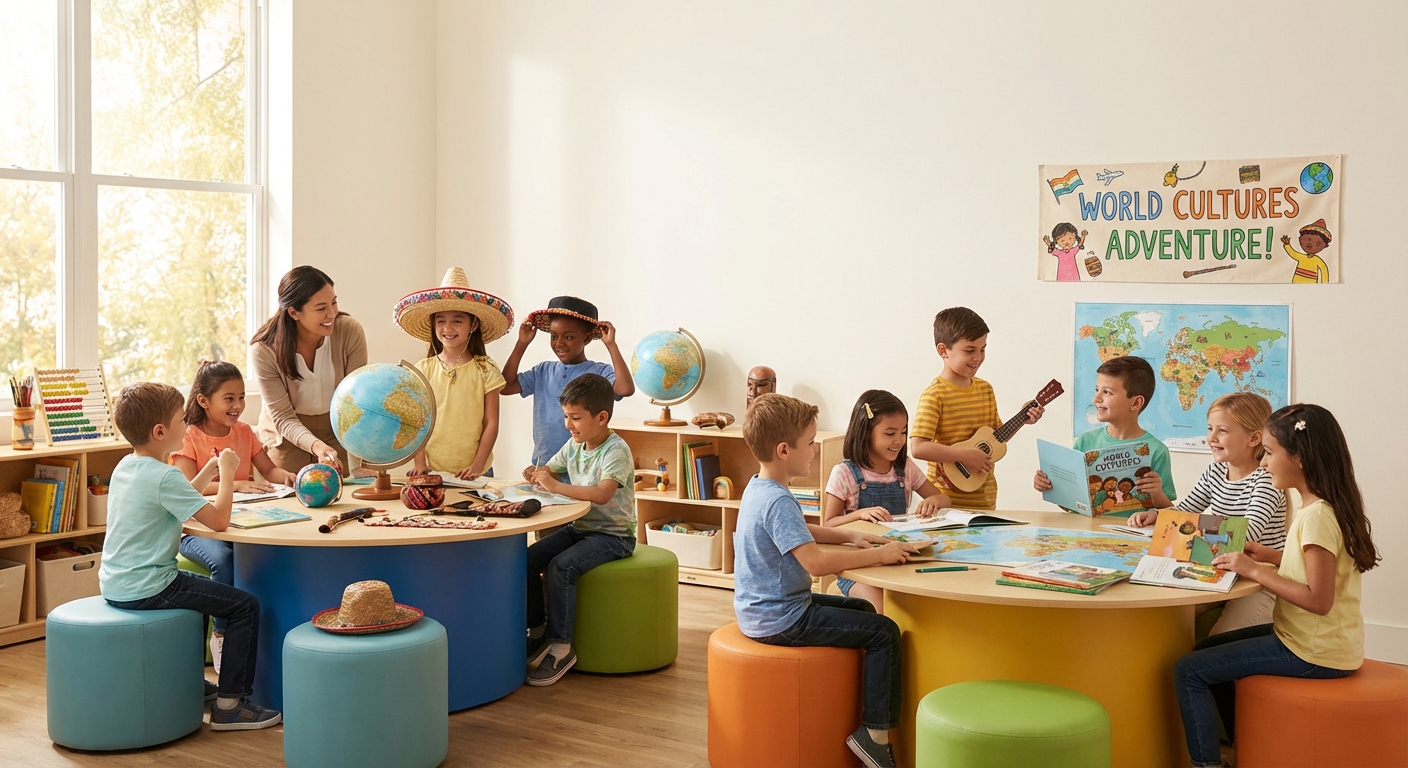
Exploring Social Customs Around the World
Every place on Earth has its own Social Customs—the ways people greet each other, share food, celebrate, and show respect. These habits help us understand Culture (the shared ideas, arts, and traditions of a group). By learning about different customs, you can expand your vocabulary, discover why people act the way they do, and see how customs shape friendships worldwide.
1. Greetings: How We Say “hello”
What You Might Hear
- Handshake – a greeting some people use in formal or familiar settings.
- Bow – a greeting used in some Japanese and Korean settings, with meaning that depends on the situation.
- Kiss On The Cheek – a greeting used by some people in parts of Europe, Latin America, and elsewhere.
Greeting customs vary by person, region, age, relationship, and setting. Never assume someone wants to be touched: observe, ask politely, or choose a friendly wave.
Cause & Effect
Cause: People develop shared ways to acknowledge one another.
Effect: A respectful greeting can help people feel recognized and welcome.
Did You Know?
The hongi is an important Māori greeting in Aotearoa New Zealand in which people may press noses and foreheads together. It is used in particular cultural settings, not as a greeting that every Māori person uses every time.
2. Sharing Meals: More Than Just Food
Common Customs
- Communal Plates – In Ethiopia, families eat from a large sourdough flatbread called injera that everyone shares.
- Leaving A Small Portion – In some cultures, like in certain parts of China when dining as a guest, leaving a small amount of food can show that your host has provided generously. However, in other cultures, like Japan or India, finishing your plate shows appreciation and avoids waste.
Cause & Effect
Cause: Sharing food shows generosity and signals that everyone is part of the same group.
Effect: It creates a feeling of belonging and can reduce arguments over “who gets the last bite.”
Vocabulary Boost
- Etiquette – the rules of polite behavior.
- Generosity – the quality of being willing to give more than you need.
3. Celebrations and Rituals
Examples
- Diwali (India) – a “Festival of Lights” where families light oil lamps to symbolize the victory of good over darkness.
- Carnival (Brazil) – a massive street party with music, colorful costumes, and dancing to celebrate before the Lenten season.
Cause & Effect
Cause: Many celebrations mark important events (like a harvest or a religious story).
Effect: They give people a chance to express joy, remember history, and pass traditions to younger generations.
Did You Know?
During the Japanese Cherry Blossom Festival (Hanami), people picnick under blooming trees to enjoy the fleeting beauty of the flowers, reminding them that life is short and should be cherished.
4. Showing Respect: Words and Actions
Typical Practices
- Using Titles – In many countries, adding “Mr.”, “Mrs.”, “Sir”, or “Madam” shows respect for elders.
- Removing Shoes – In Thailand and many Middle Eastern homes, taking off shoes before entering keeps the floor clean and honors the household.
Cause & Effect
Cause: Respectful language and gestures signal that you value others’ feelings and status.
Effect: It reduces misunderstandings and helps maintain harmony in families, schools, and workplaces.
Vocabulary Boost
- Hierarchy – a system where people are ranked one above another.
- Politeness – the act of being courteous and considerate.
Mini Quiz & Experiment
Quiz (circle the right answer)
-
Which greeting involves a gentle bend at the waist?
a) Handshake b) Bow c) Kiss on the cheek -
When dining etiquette is unfamiliar, what is the best choice?
a) Assume one rule applies everywhere
b) Observe and politely ask the host ✓
c) Insult the food -
The lanterns lit during Diwali represent the victory of ______ over ______. a) Night over Day b) Good (Light) over Darkness c) Winter over Summer Answer: b) Good (Light) over Darkness
Experiment: Create Your Own Greeting
- Invent a new greeting for your family or classroom.
- Decide: Will it be a handshake, a special wave, or a fun phrase?
- Teach it to your friends and see if it catches on!
What to Observe: How did it feel to create something new? Did others enjoy learning it?
Wrap‑up
Social customs are like invisible threads that connect people across the world. Whether it’s a bow in Japan, a kiss on the cheek in France, or sharing injera in Ethiopia, these traditions help us show respect, build friendships, and celebrate together. Next time you meet someone from a different culture, ask them about their customs—you might learn something wonderful!