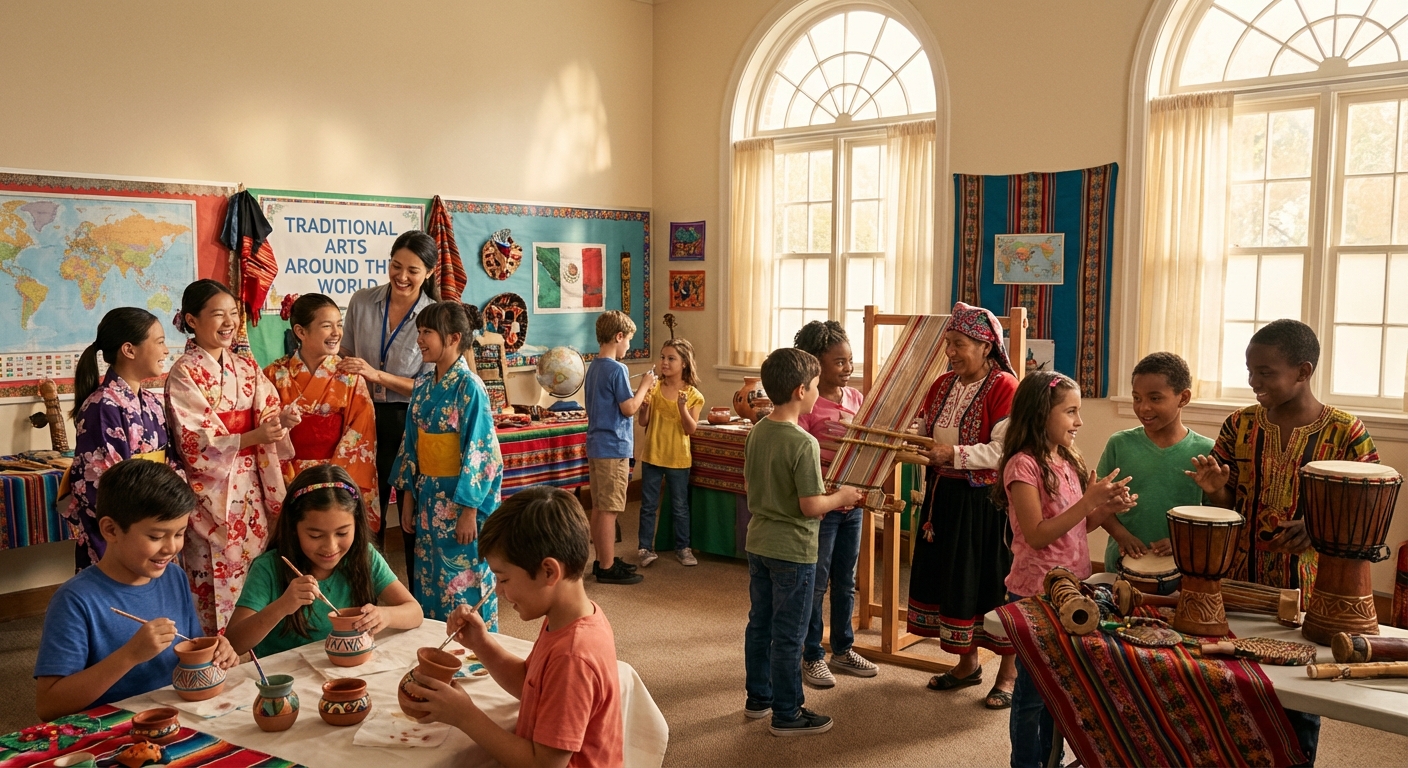
Traditional Arts Around the World
Artists inherit, teach, and transform practices such as painting, dance, carving, pottery, and weaving. Traditional Arts are living forms: artists may use old or new tools while maintaining, questioning, or changing community traditions.
1. Patterns on Cloth: Textiles from India and Peru
What It Is: Cloth can be tied, dyed, spun, woven, printed, or embroidered using many different techniques.
- Bandhani: Artists in parts of western India, especially Gujarat and Rajasthan, and nearby regions tightly tie tiny areas of cloth before dyeing. The tied areas resist the dye and form patterns.
- Andean Textiles: Weavers in different Andean communities work with fibers such as alpaca, llama, sheep wool, and cotton. Materials, methods, and designs vary by time and place.
Cause And Effect: Local environments affect which fibers are available, while trade, migration, technology, and artistic choice also matter. Some textile patterns carry community, family, religious, political, or personal meanings; others are created for different purposes.
New Vocabulary:
- Textile – a material made of threads or fibers, like cloth.
- Geometric – shaped like squares, triangles, circles, etc.
2. Stories in Clay: Pottery from Africa and Japan
What It Is: Artists shape clay into practical, ceremonial, or sculptural forms, then dry and fire it.
- Pottery in Nigeria: Nigeria is home to many distinct pottery traditions. Artists may build vessels with coils or other techniques, and forms and uses vary by community and maker.
- Japanese Raku Ware: Raku ware developed in connection with tea culture. Pieces are shaped and fired with particular methods; surfaces vary and are not always crackled.
Cause And Effect: Clay composition, added materials, forming, drying, glaze, fuel, kiln design, and firing temperature all affect a finished piece. Some vessels help store food or water; others are made for ceremony, trade, memory, or art.
Did You Know? Potters in many parts of the world add materials called temper to some clay mixtures. Temper can change shrinkage, strength, or firing behavior, but it does not guarantee that a pot will never crack.
New Vocabulary:
- Coiling – a method of building up clay by stacking rolled ropes of clay.
- Temper – a material added to clay to improve its strength.
3. Music and Movement: Indigenous Dance and Mask Making
What It Is: Performances that combine rhythm, costume, and storytelling.
- Aboriginal and Torres Strait Islander Performance: Australia has hundreds of distinct peoples and languages. Songs, dances, designs, and ochre may have specific owners, meanings, and rules; some can be shared publicly and others are restricted.
- Día de Muertos Arts in Mexico: Practices vary by region and family. Artists may create paper decorations, sculptures, painted faces, or other works to remember people who have died; no single mask represents the whole tradition.
Cause And Effect: Creating and performing together can support teaching, remembrance, identity, or celebration. The instruments, meanings, and participation rules depend on the community and event.
New Vocabulary:
- Papier‑mâché – paper pieces glued together with a sticky mixture to make a solid shape.
- Ochre – a natural earth pigment that comes in reds, yellows, and browns.
Mini Experiment: Model a Resist Pattern on Paper
You’ll Need:
- Thick paper
- A white wax crayon
- Washable watercolor paint and a brush
- A small cup of water
- A cover for your work surface
- An adult to help set up and supervise
Steps:
- Cover the work surface and draw a pattern of dots and lines with the white crayon.
- Brush washable watercolor over the paper.
- Observe where the wax resists, or blocks, the watery paint.
- Let the paper dry and compare the visible pattern with your original drawing.
What’s Happening? The wax resists the watercolor. This models the general idea of resist dyeing, but it is not Bandhani. Authentic Bandhani is a skilled regional textile tradition in which artists tightly tie cloth before dyeing it. Learn from named artists or museum sources, and do not label this paper experiment as your own Bandhani work.