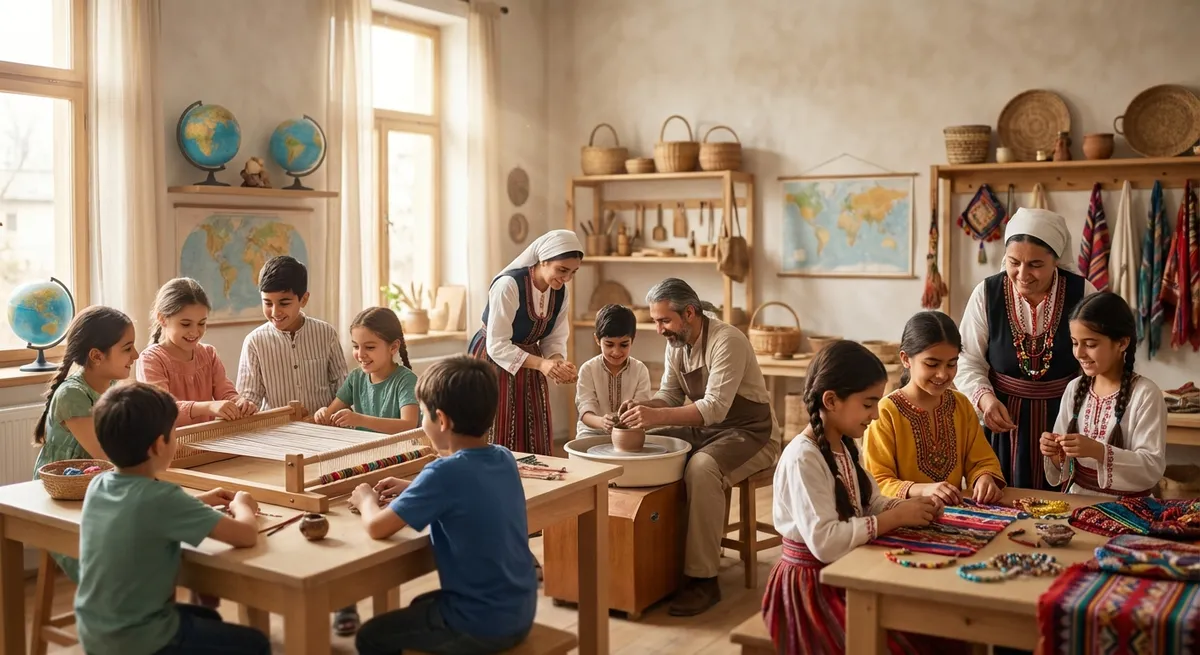
Traditional Crafts from Around the World
Every culture has its own special ways of turning ordinary things—like grass, clay, or paper—into beautiful, useful objects. These “traditional crafts” are more than just art; they tell stories about history, geography, and daily life. In this guide you’ll learn new vocabulary, discover cool examples, see how cause & effect shape a craft, and even try a mini experiment yourself!
1. Weaving Wonders 🌾
What It Is: Weaving is the process of interlacing threads or strips of material to make fabric, rugs, or baskets.
Where It’s Popular: The Andean peoples of South America use a loom (a frame that holds the threads) to create colorful blankets called ponchos. In Ghana, the kente cloth is woven with bright stripes that represent important events.
Cause & Effect:
- Cause: Communities lived where cotton, wool, or plant fibers grew abundantly.
- Effect: They invented weaving techniques that turned those fibers into clothing and trade goods.
Did You Know? The word Artisan (a skilled craftsperson) comes from the Latin art meaning “skill” or “craft.”
New Vocabulary:
- Loom – a tool that holds warp (vertical) threads while weft (horizontal) threads are passed through.
- Motif – a repeated decorative design, like the zig‑zag pattern on a Navajo rug.
2. Clay and Pottery 🏺
What It Is: Potters shape soft clay into bowls, pots, or sculptures and then fire them in a kiln (a super‑hot oven) to make them hard.
Where It’s Popular:
- Japan: Raku pottery is fired at low temperatures, giving it a smoky, crackled surface.
- Nigeria: The Igbo people make urns that are used in ceremonies and to store water.
Cause & Effect:
- Cause: Clay is found near rivers and lakes, and it becomes plastic (moldable) when mixed with water.
- Effect: Early societies could store food and water, which helped villages grow larger.
Did You Know? The term Kiln comes from the Old English cylene, meaning “to fire.”
3. Paper Cutting and Folding ✂️
What It Is: Using thin paper to create pictures (origami) or cut designs (kirigami).
Where It’s Popular:
- China: Intricate paper cuttings called jianzhi decorate windows during festivals.
- Mexico: Papel picado (pierced paper) hangs at celebrations, showing delicate silhouettes of birds, flowers, and stars.
Cause & Effect:
- Cause: Paper became cheap after the invention of wood‑pulp paper in the 19th century.
- Effect: Artists could experiment with new, affordable designs, spreading