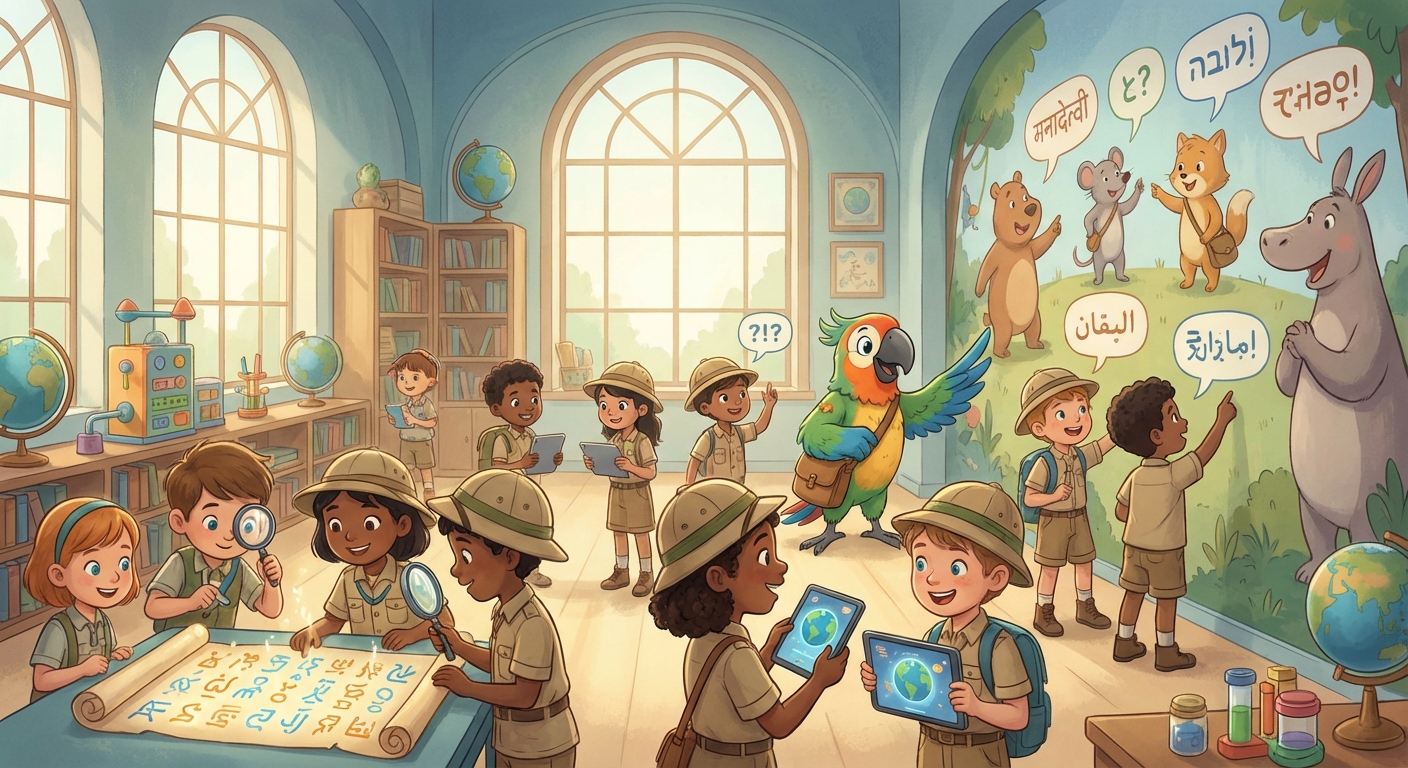
Languages
Every day people all over the planet speak words that sound different, write in different letters, and even use gestures that are unique to their culture. These ways of communicating are called Languages. Learning about them helps us understand how people live, think, and share ideas across the globe.
1. How Many Languages Are There?
- Fact: There are About 7,000 languages spoken today!
- Cause & Effect: Long ago, groups of people moved to new lands and became separated from each other. Because they could no longer hear each other’s words, their speech Changed Over Time, creating new languages.
Example:
- English started as a mix of Anglo‑Saxon, Norse, and French words.
- Mandarin Chinese grew from many regional spoken forms that eventually became the standard language of China.
Vocabulary Boost:
- Dialect – a regional variation of a language (e.g., the way people speak in Texas vs. New York).
- Bilingual – a person who can speak two languages fluently.
2. Why Do Some Languages Spread?
When people travel, trade, or explore, they bring their language with them.
- Cause: The Silk Road was a network of trade routes connecting Asia, Europe, and Africa.
- Effect: Words like “cotton,” “sugar,” and “tea” traveled along the route, and the languages of traders mixed, giving us loanwords (words borrowed from another language).
Did You Know? The word “Coffee” comes from the Arabic word qahwa, which traveled to Europe through Turkish traders.
3. Languages and Culture
Language can offer clues about history and culture, but it does not determine what every speaker values or how every speaker behaves.
- In Japanese, -san is a respectful title often added to a person’s name. It is not a word meaning “you.” Which title or form of address is suitable depends on the relationship and setting.
- Greeting customs vary across Spanish-speaking communities and by age, relationship, region, setting, and preference. Some people use handshakes, hugs, or cheek kisses; never assume someone wants physical contact.
Cause & Effect: Contact between communities can add loanwords and new expressions to a language. Speakers also adapt language as technology, society, and daily life change.
4. Mini Experiment: “hello, World!”
What You Need:
- A smartphone, tablet, or computer with internet access.
- A notebook and a pencil.
Steps:
- Choose Four languages from different regions (for example, Portuguese, Japanese, Swahili, and Swedish). Remember that a country may have many languages and a language may be spoken in many countries.
- With a trusted adult, use a dictionary, language-learning source, or recording by a fluent speaker to find a greeting. Write it down and listen before trying it aloud.
- Record how the sounds feel: Are they short or long? Do they use tones (high‑low pitch) like in Mandarin?
- Share your new greetings with family or friends and see if they can guess which country each one belongs to!
What You’ll Learn: You’ll notice how sounds, rhythm, and even body language (like a bow vs. a wave) differ between languages.
Quick Quiz
| Question | Answer |
|---|---|
| 1️⃣ How many languages are spoken worldwide? | About 7,000 |
| 2️⃣ What do we call a word borrowed from another language? | Loanword |
| 3️⃣ What does “bilingual” mean? | Speaking two languages fluently |
| 4️⃣ Which trade route helped spread many words across continents? | The Silk Road |
| 5️⃣ True or False: All people in a country speak the same language? | False |
Explore languages and discover how wonderfully diverse our world is!