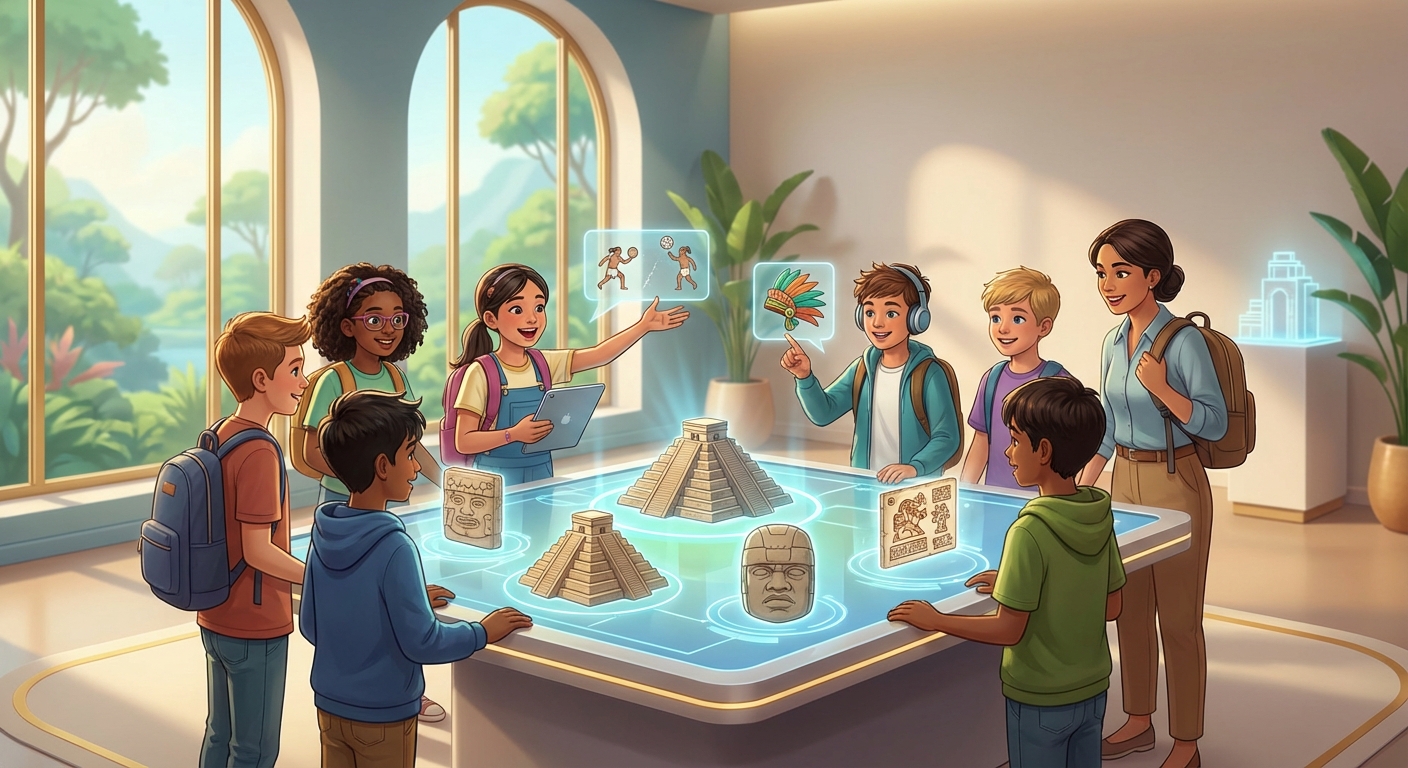
Mesoamerican Civilizations
What Is Mesoamerica?
Mesoamerica is a region in Central America that includes parts of today’s Mexico, Guatemala, Belize, Honduras, and El Salvador. Long before Europeans arrived, many peoples lived here and built impressive cities. The climate varies from jungles to high mountains, so people had to adapt their farms, houses, and tools to different environments.
Major Civilizations
The Olmec (c. 1500–400 Bc)
The Olmec are often called an early influential culture of Mesoamerica, though later societies developed in their own ways. They carved colossal stone heads and built some of the region’s earliest monumental structures. They also used symbolic systems that may have influenced later writing traditions, but scholars debate which surviving marks count as full writing.
The Maya (c. 2000 Bc–900 Ad)
The Maya lived in the Yucatán Peninsula, Guatemala, and nearby areas. They built towering pyramids at sites like Tikal and Chichen Itza. The Maya invented a calendar that could predict eclipses and a sophisticated hieroglyphic script. They loved astronomy, mathematics, and the game of pok‑a‑pok (a ball game with ritual meaning).
The Aztec (c. 1300–1521 Ad)
The Aztec empire centered on the city of Tenochtitlán, where modern Mexico City stands. They expanded farmland using raised plots called chinampas and built massive temples on solid ceremonial centers in the city. The Aztec were skilled engineers, traders, and warriors. Their empire fell after Spanish forces and Indigenous allies captured Tenochtitlán in 1521.
Everyday Life
- Food: Most people grew corn (maize), beans, squash, and chilies. They also hunted deer, fish, and birds.
- Housing: Families lived in houses made of mud bricks or wood. In the Maya lowlands, homes were built on stone platforms; in the Aztec capital, houses were stacked closely together.
- Clothing: Cotton and woven fibers were common. Men often wore simple loincloths, while women wore long skirts. Bright colors showed status and celebrations.
- Religion: Gods of rain, corn, and war were important. Temples were built for ceremonies, and many rituals involved music, dancing, and sometimes human sacrifice.
Legacy
Mesoamerican ideas still influence the world today. Maya calendar traditions continue in Maya communities, and the English word “chocolate” ultimately comes through Spanish from a Nahuatl word. Many cities in Mexico and Central America stand near or over ancient sites, reminding us of the ingenuity of these societies. By studying their achievements, we learn how people can adapt, create, and thrive in diverse environments.