Space Race
Why the Race Started
After World War II, the United States and the Soviet Union became the two strongest countries on Earth. Both wanted to show that their political system was the best. One way to prove it was by sending rockets and people into space. The first successful launch of a satellite, Sputnik 1, by the Soviet Union in 1957 shocked the world and made the United States start its own space program. The competition quickly turned into a “race” to be the first to reach new milestones in space.
Key Moments
- 1957 – Sputnik 1: The first artificial satellite, a metal sphere that beeped as it orbited Earth.
- 1961 – Yuri Gagarin: The Soviet cosmonaut became the first human to travel into space, circling the planet once.
- 1969 – Apollo 11: The United States landed astronauts Neil Armstrong and Buzz Aldrin on the Moon, fulfilling President Kennedy’s promise to “reach the Moon before the decade is out.”
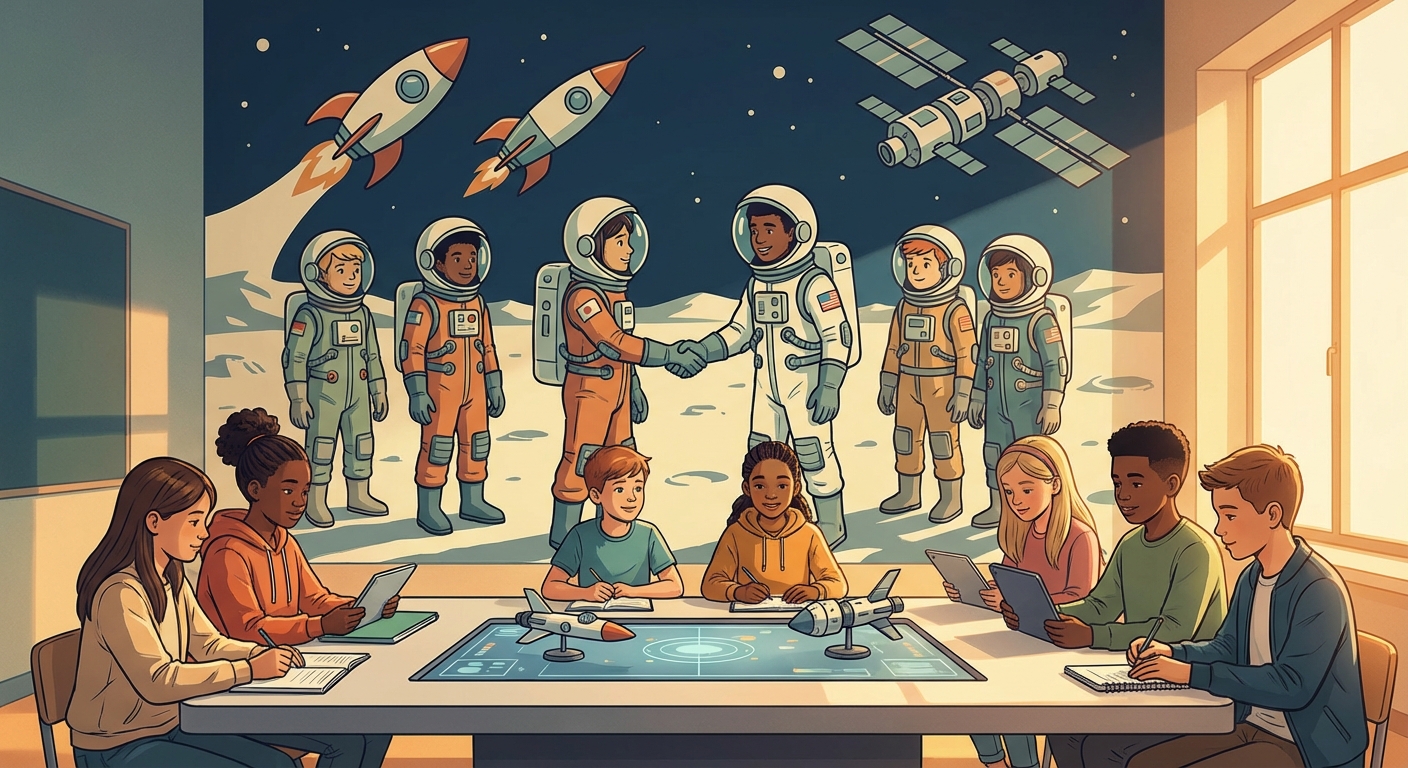
- 1975 – Apollo–Soyuz Test Project: The United States and Soviet Union docked their spacecraft together, showing that cooperation was possible after years of competition.
Lasting Impact
The Space Race pushed technology forward at a break‑neck speed. Mini‑computers, satellite communications, and new materials were created for rockets and later used in everyday life. It also inspired generations of scientists, engineers, and explorers. Today, many countries work together on projects like the International Space Station, building on the daring spirit of the original race. The lesson is clear: competition can spark great inventions, but collaboration can take those inventions even farther.