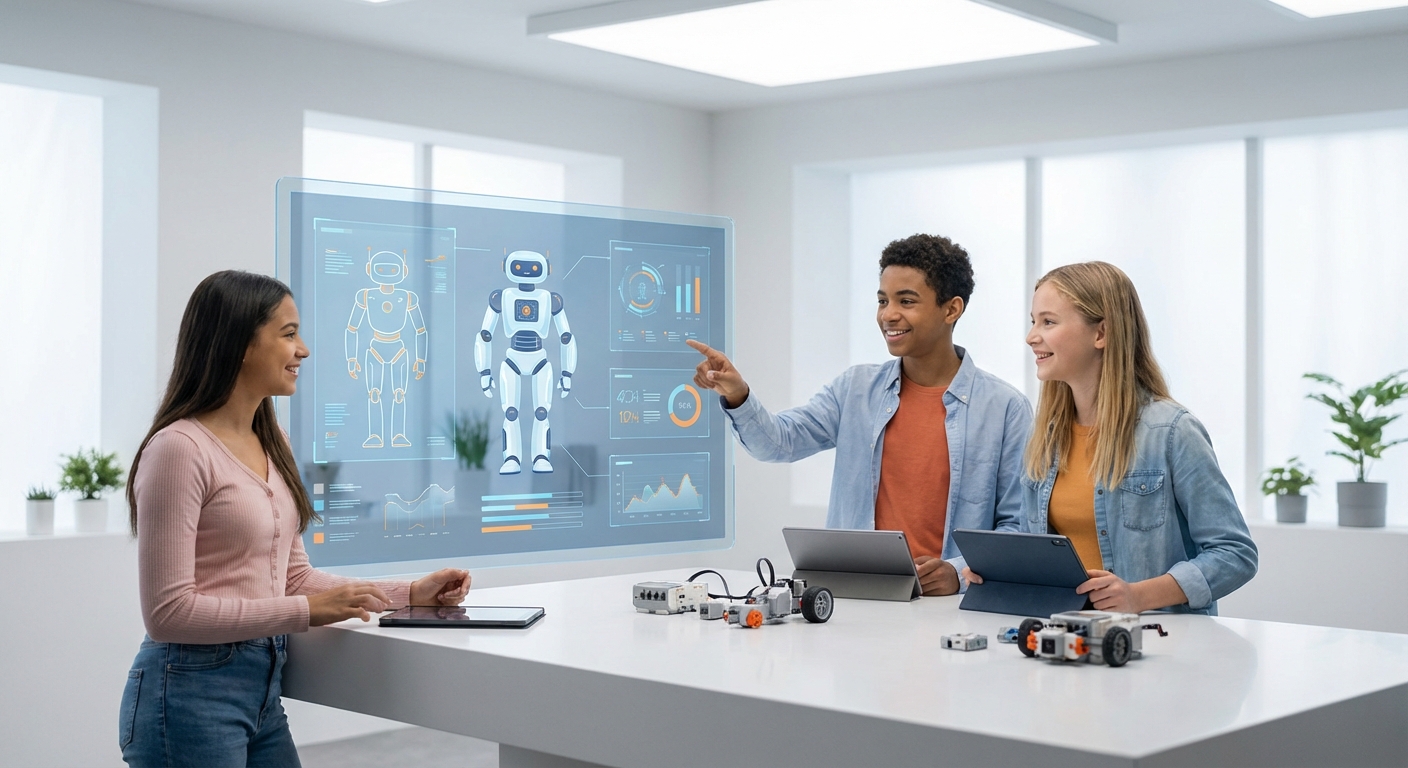
The Future of Robotics: Advanced Concepts for Young Innovators
Robotics blends mechanical design, computer science, and electrical engineering to create machines that act autonomously.
At the high‑school level, students can explore sophisticated topics such as dynamic control, sensor fusion, and ethical deployment.
This guide challenges curious minds to analyse cutting‑edge research, consider diverse perspectives, and envision future careers.
1. Kinematics, Dynamics, and Control
Understanding how robots move requires mastering kinematics, which describes motion without regard to forces.
Dynamic analysis adds the influence of masses, torques, and inertia, enabling realistic simulation of real‑world behavior.
Control theory translates desired trajectories into motor commands, using feedback loops like PID (proportional‑integral‑derivative).
Advanced researchers experiment with model‑predictive control, allowing robots to anticipate future states and adjust preemptively.
Career paths such as mechatronics engineer or control systems specialist rely heavily on these mathematical foundations.
2. Sensors, Perception, and Sensor Fusion
Robots perceive their environment through cameras, lidar, force sensors, and inertial measurement units.
Perception algorithms convert raw data into meaningful representations, such as point clouds or semantic maps.
Sensor fusion combines multiple modalities, reducing uncertainty and improving reliability in complex settings.
Research challenges have demonstrated autonomous drones that combine cameras, inertial sensors, lidar, and other signals to navigate accurately, including in places where GPS is unavailable or unreliable.
Students interested in computer vision or embedded hardware can pursue roles as perception engineers or sensor designers.
3. Artificial Intelligence Integration
Machine learning empowers robots to adapt, recognize patterns, and make decisions beyond pre‑programmed rules.
Deep reinforcement learning enables agents to discover optimal policies through trial‑and‑error interaction with simulated worlds.
Natural language processing allows collaborative robots (cobots) to understand spoken commands and respond conversationally.
Research from institutions like MIT’s Computer Science and Artificial Intelligence Laboratory demonstrates robots that learn manipulation tasks from a handful of demonstrations.
Future AI‑focused robotics careers include research scientist, data‑driven algorithm developer, and ethical AI auditor.
4. Ethical, Societal, and Economic Perspectives
Advanced robotics raises questions about labor displacement, privacy, and algorithmic bias.
Economists argue that automation can increase productivity while creating new job categories that require higher skill levels.
Philosophers caution that autonomous weapons and surveillance bots may erode civil liberties if unchecked.
Policy analysts recommend interdisciplinary oversight committees to balance innovation with public interest.
Considering multiple viewpoints prepares students to become responsible technologists and informed citizens.
Robotics Advanced Quiz
Keep Exploring
Share one real-world robot that excites or worries you and ask a friend how they would redesign it for good. Comparing answers turns today’s unknowns into your next experiment together.