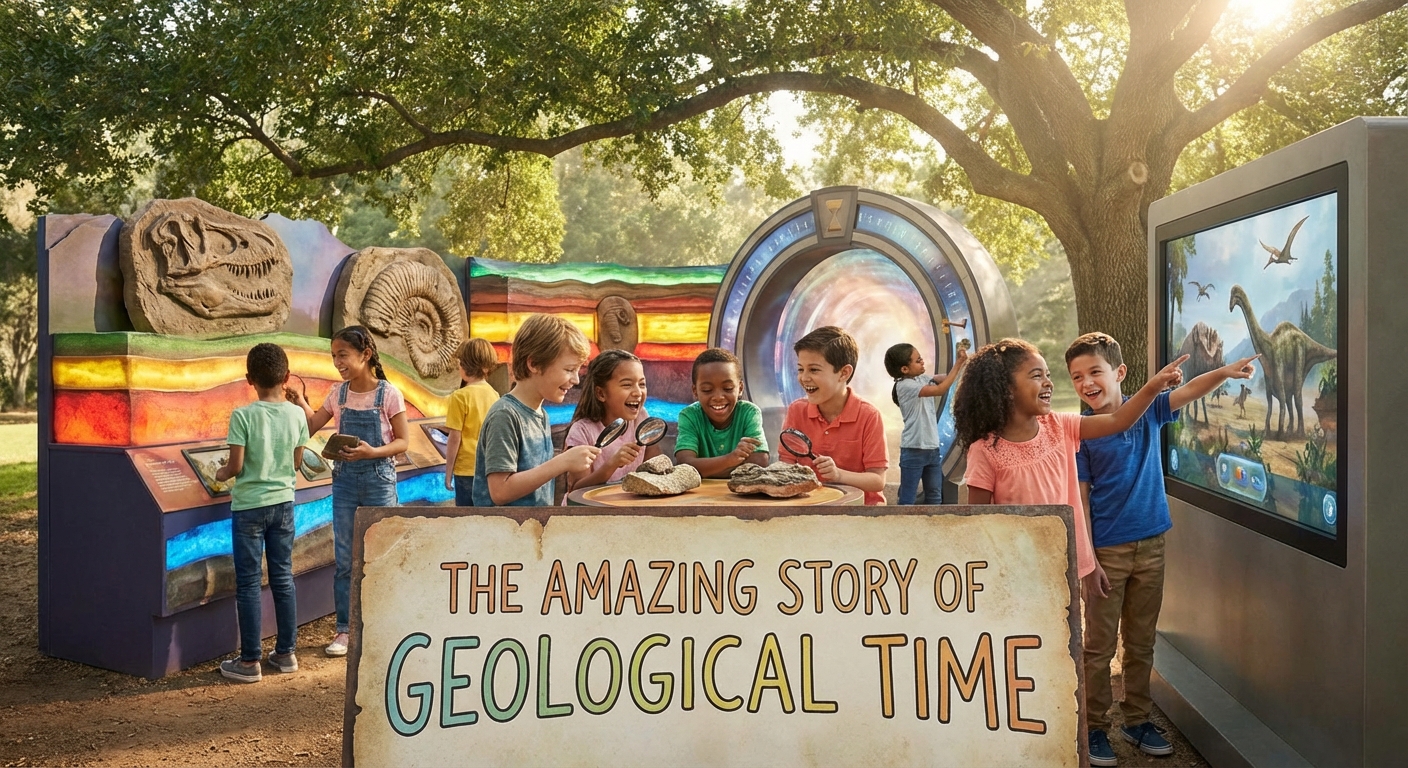
The Amazing Story of Geological Time
Ever wonder how scientists know that dinosaurs lived Millions of years ago? They read the Earth’s own diary—its rocks! This diary is called Geological Time, a way to understand the huge stretch of history that happened Before humans were even born. Let’s travel back in time (without a time machine) and discover how the planet changed, layer by layer.
1. What Is Geological Time?
Geological time is a Timeline that scientists use to break Earth’s 4.5‑billion‑year history into manageable parts. Think of it like a giant pizza sliced into big pieces, then smaller slices, then tiny toppings.
| Scale | Meaning | Example |
|---|---|---|
| Eon (pronounced EE‑on) | The biggest slice – billions of years | Phanerozoic eon: the time when visible life appears |
| Era | A big chunk of an eon – hundreds of millions of years | Mesozoic era: age of the dinosaurs |
| Period | Smaller pieces of an era – tens of millions of years | Cretaceous period: when T. rex roamed |
| Epoch | The tiniest slice – a few million years | Holocene epoch: the time we live in now |
Did You Know? The word eon comes from the Greek word for “age” or “life‑time.”
2. How Rocks Record Time
Rocks are like Pages in Earth’s diary. Different types of rocks tell different stories:
- Sedimentary Rocks form when tiny particles (Sediment) settle in layers, like sand in a glass jar. Fossils—Preserved Remains Of Ancient Plants Or Animals—often get trapped in these layers.
- Igneous Rocks are born from molten lava that cools and hardens, giving clues about volcanic eruptions.
- Metamorphic Rocks are once‑ordinary rocks that get Transformed by heat and pressure deep underground.
Cause & Effect: When a volcano erupts (cause), it spreads lava that later cools into igneous rock (effect). Over millions of years, that rock can be buried, heated, and become metamorphic rock.
3. Big Events in Earth’s Past
A. the Great Oxygen Boom (≈2.4 Billion Years Ago)
Tiny cyanobacteria started making oxygen through photosynthesis. The atmosphere filled with oxygen, allowing larger animals to evolve later.
B. the Age of Dinosaurs (≈252–66 Million Years Ago)
During the Mesozoic era, dinosaurs ruled the land, sea, and sky. A massive asteroid impact caused a sudden climate shift, leading to their extinction—a dramatic Cause‑and‑effect chain.
C. Ice Ages (≈2.6 Million Years Ago to Present)
Glaciers grew and shrank many times, carving valleys and shaping continents. When the climate warmed, ice melted, raising sea levels and creating new habitats.
Did You Know? The last Ice Age ended only about 12,000 years ago—just a blink in geological time!
4. Mini Experiment: Build Your Own Layered Rock!
What You Need
- A clear plastic bottle or jar
- Sand, small pebbles, and soil
- Food coloring and water
- A spoon
Steps
- Layer 1 – Pebbles: Add a thin layer of pebbles.
- Layer 2 – Sand: Add a layer of sand. Pour slowly so the layers stay visible.
- Layer 3 – Soil: Add a thin layer of soil.
- Add Water: Mix water with one drop of food coloring, then slowly pour in enough to dampen the layers.
- Observe: Notice how newer material sits above older material. This is a model: real sedimentary layers form through many processes over long periods of time.