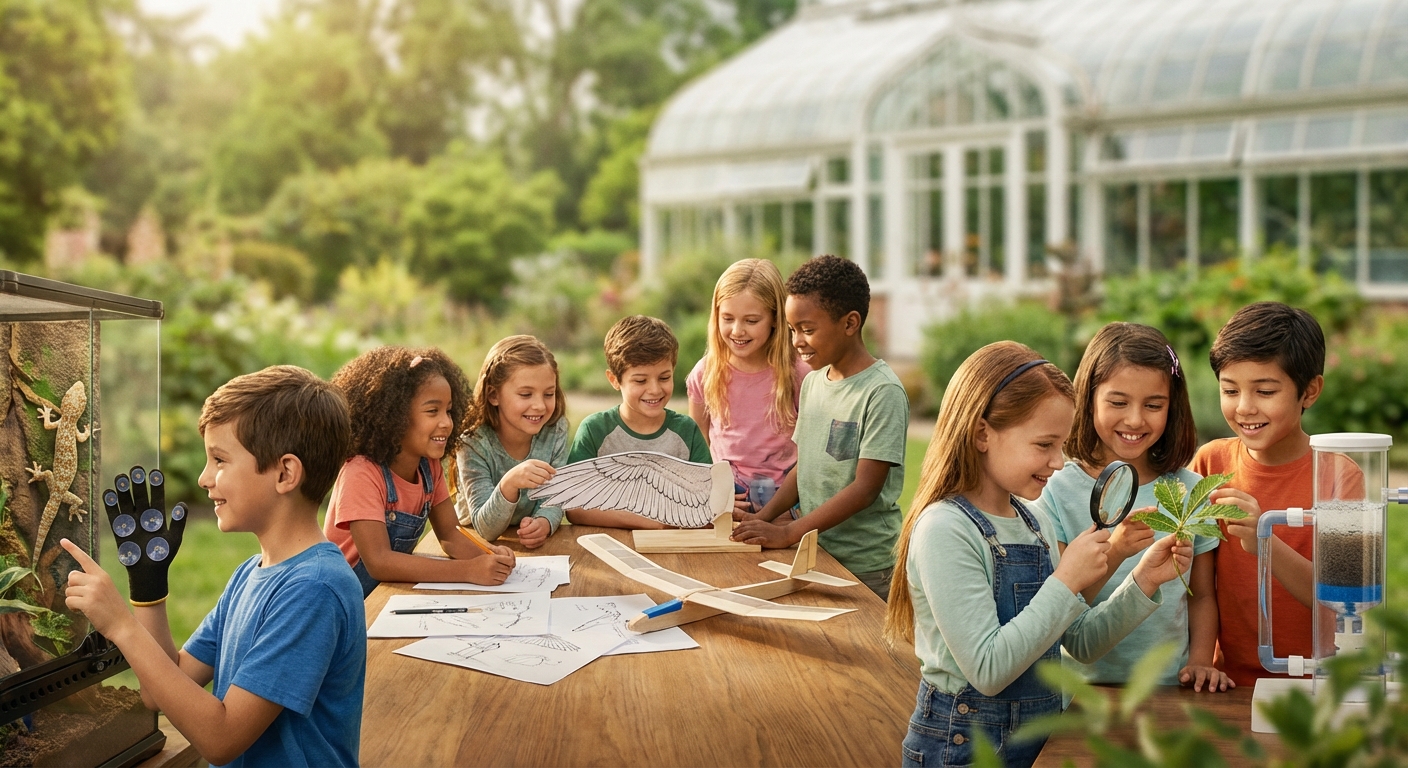
Biomimicry: Engineering Inspired by Nature
Have you ever wondered why a plane’s wing looks like a bird’s wing, or why a building might “breathe” like a tree? Biomimicry is the clever practice of copying nature’s smart designs to solve human problems. Engineers study animals, plants, and even tiny microbes to create inventions that are stronger, faster, and kinder to the Earth.
1. What Is Biomimicry?
Biomimicry (ˈbī‑ō‑mi‑mē‑krē) = bio (life) + mimicry (copying).
- Definition: Using the shapes, processes, or strategies found in living things to design new tools, machines, or structures.
- Why It Works: Nature has been “testing” ideas for billions of years. If a leaf can stay dry in rain, engineers can learn that trick for better umbrellas.
Cause And Effect:
Cause – A beetle’s shell repels water.
Effect – Engineers create water‑repellent paints that keep walls dry.
2. Nature’s Blueprints in Engineering
| Nature’s Feature | Engineering Copy | How It Helps |
|---|---|---|
| Shark Skin – tiny rib‑like scales | Shark‑skin Swimsuits & Ship Hulls | Reduce drag, letting swimmers go faster and ships use less fuel. |
| Kingfisher Beak – long, pointed, low‑noise | High‑speed Trains (E.g., Japan’s Shinkansen) | Cuts through air smoothly, lowering noise and energy use. |
| Termite Mounds – natural ventilation | Energy‑saving Buildings | Keep indoor air fresh without big air‑conditioners. |
Complex word: Aerodynamics – the study of how air moves around objects. A design with good aerodynamics “cuts” through air easily, like a fast fish slicing water.
3. Cool Inventions Inspired by Animals
A. Velcro – The Burr’s Hook
Swiss engineer George de Mestral noticed how burrs (those sticky plant seeds) clung to his dog’s fur. He copied the tiny hooks and made Velcro, a fastener that sticks and unsticks in a snap.
B. Gecko‑inspired Adhesives
Geckos can walk up walls because of millions of microscopic hairs on their feet. Scientists created Gecko Tape that can hold objects without glue, useful in space missions where you can’t use messy adhesives.
C. Lotus‑effect Surfaces
Lotus leaves stay clean because water droplets roll off, taking dirt with them. Engineers coat glass and solar panels with a Lotus‑effect coating, so they stay clear and work better.
4. Did You Know?
- The Hummingbird’s Wing beats up to 80 times per second! Engineers use that rapid motion to design tiny drones that hover like insects.
- Spider Silk is remarkably strong and light. Some types have tensile strength comparable to certain steels while weighing much less, but the exact comparison depends on the materials tested. Researchers study silk-like fibers for lightweight materials and medical uses.
- Octopuses can rapidly change their skin color and texture. Researchers study this ability while developing materials that can change their appearance.
Mini Design Activity: Learn From a Fish
What You Need
- Paper
- Pencil or crayons
- A picture of a fast-swimming fish from a trusted book or website
Steps
- Look closely at the animal’s body shape, fins, skin, and tail.
- Circle one feature that may help it move, steer, or stay stable.
- Sketch a water vehicle inspired by that feature.
- Label what you copied and what problem it might solve.
This is an engineering idea, not proof that the design works. Engineers would build and test a fair model next.
Quiz: Test Your Biomimicry Knowledge
-
Which Living Thing Inspired Velcro?
a) Bee
b) Burr plant ✓
c) Gecko
d) Hummingbird -
What Is The Main Benefit Of The Lotus‑effect Coating?
a) Makes things smell nice
b) Helps water roll off and carry dirt away ✓
c) Changes the colour of surfaces
d) Makes surfaces magnetic -
Why Do Termite Mounds Help Engineers Design Energy‑saving Buildings?
a) They are very strong
b) They store water
c) They have natural ventilation that moves air without fans ✓
d) They are made of metal -
What Does “Aerodynamics” Study?
a) How plants grow
b) How air moves around objects ✓
c) How sound travels underwater
d) How insects see -
Gecko‑inspired Tape Can Stick Without Glue Because Of:
a) Tiny magnets
b) Microscopic hairs that create a gentle suction ✓
c) Sticky chemicals
d) Heat
Conclusion:
Biomimicry shows us that by looking at nature’s clever tricks, we can invent smarter, greener solutions for the world.