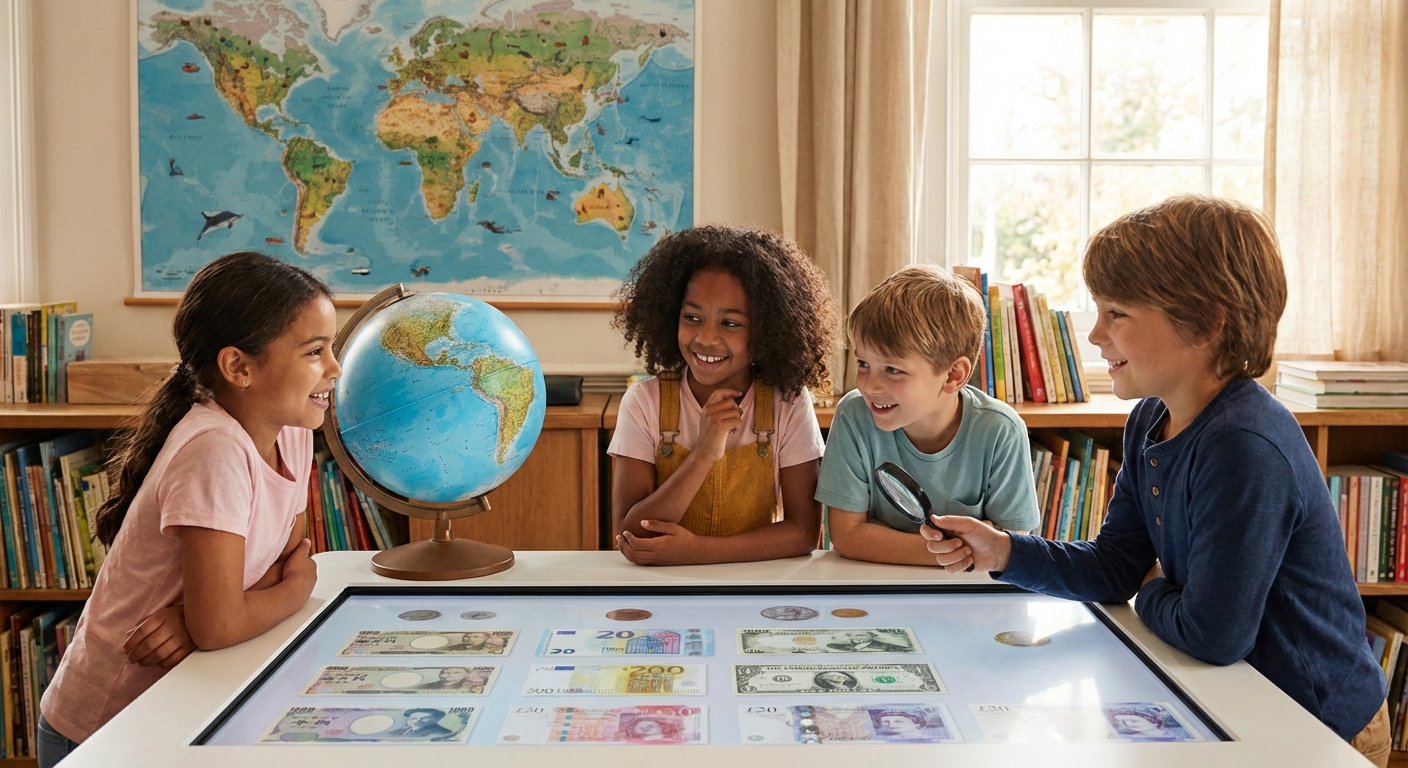
Money Around the World: A Kid’s Guide to Currencies
Countries and regions use Currencies—systems of money used to buy things, pay for services, and save. Some countries share a currency, such as the euro, while others officially use another country’s money. These systems help people trade without having to barter (swap) items directly.
1. What Is a Currency?
A Currency is the official system of money that a country or region uses. It can be paper notes, metal Coins, or even digital numbers in a bank account.
| Term | Kid‑Friendly Definition | Example |
|---|---|---|
| Denomination | The value printed on a bill or stamped on a coin | A $5 bill, a 1‑euro coin |
| Legal Tender | Money officially recognized for settling payments or debts under a place’s laws | U.S. dollars, British pounds |
| Exchange Rate | The changing price of one currency when traded for another | If 1 unit buys 0.85 units of another currency, the rate is 0.85 |
Did You Know? The word currency comes from the Latin currere, which means “to run.” Money is always moving—changing hands, traveling across borders, and flowing through economies!
2. A Quick Tour of Some Famous Currencies
| Country | Currency | Fun Fact |
|---|---|---|
| United States | Dollar (Usd) | The $1 bill features George Washington, the first U.S. president. |
| United Kingdom | Pound Sterling (Gbp) | The word pound comes from the weight of a pound of silver used long ago. |
| Japan | Yen (JPY) | The ¥ symbol is used for the Japanese yen and can also represent the Chinese yuan, so context matters. |
| Brazil | Real (Brl) | The modern real was introduced in 1994; its name is related to a Portuguese word for “royal.” |
| South Africa | Rand (Zar) | The rand is named after the Witwatersrand, a ridge linked to major gold deposits. |
Why Do Countries Have Different Money?
Cause: Each nation decides its own currency to control its Economy (how money is made, spent, and saved).
Effect: When people travel or trade with other countries, they must Convert their money using the exchange rate. This can make buying souvenirs cheaper or more expensive, depending on the rate.
3. How Exchange Rates Affect Everyday Life
Imagine a made-up practice rate where 1 U.S. dollar equals 0.85 euros. At that practice rate, 100 dollars would equal 85 euros before any fees. Real rates change often, so an adult should check a reliable current source before exchanging money.
- If The Euro Gets Stronger (exchange rate drops to 0.80), your 100 dollars will turn into only 80 euros—your buying power shrinks.
- If The Euro Gets Weaker (exchange rate rises to 0.90), you’ll get 90 euros—your money goes farther!
This is why travelers watch exchange rates before they go abroad.
Did You Know? The word inflation describes a situation where prices rise and each unit of currency buys less. High inflation can make a country’s currency lose value compared to others.
4. Mini Experiment: “make Your Own Currency”
What You Need
- Blank paper or cardstock
- Markers or crayons
- A ruler (optional)
Steps
- Design a bill for an imaginary country. Choose a name (e.g., “Sunshine Coins”) and decide on denominations (1, 5, 10).
- Add Details: draw a picture of something special about your country (a volcano, a dolphin, a famous building).
- Create A Simple Exchange Rate: decide how many of your Sunshine Coins equal 1 USD (or your local currency) and write it on each bill.
- Trade With A Friend: swap your coins for theirs using the exchange rate and see who ends up with more spending power!