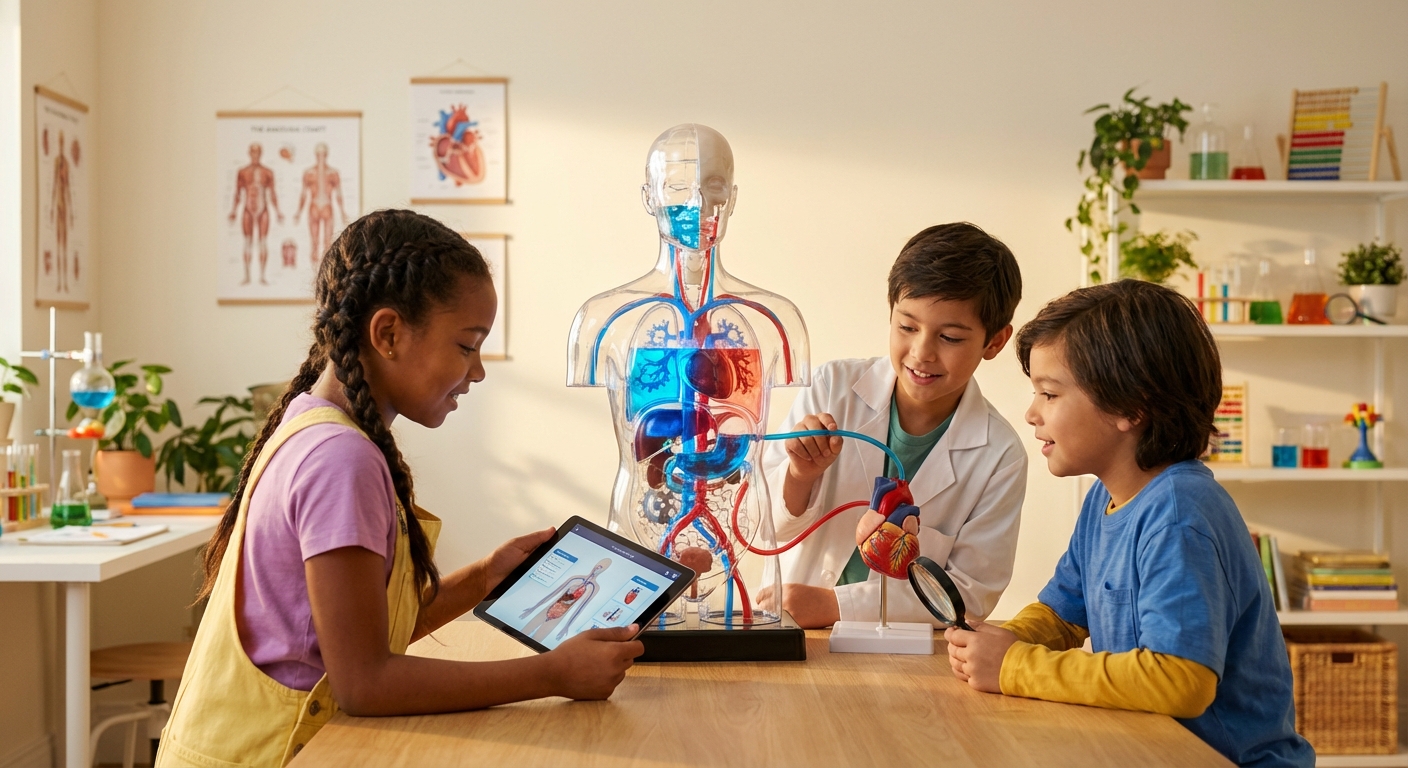
Human Body Systems
The Skeletal System
Your skeleton is the hard frame inside your body. It is made of many bones that protect your brain, heart, and lungs. Bones also give your body shape and work with muscles to help you move. Children generally have more separate bones than adults because some bones join as they grow. A typical adult skeleton is counted as 206 bones, although counts can vary.
The Muscular System
Muscles let you move. They work together with your bones like a team. There are three kinds of muscles:
- Skeletal Muscles are the ones you can see and control, like the muscles in your arms that lift a book.
- Heart Muscle (the cardiac muscle) beats all the time to pump blood.
- Smooth Muscles are inside organs, such as the stomach, and they work without you thinking about them.
When you run, jump, or even smile, your muscles are hard at work.
The Digestive System
The digestive system turns the food you eat into energy. It starts in your mouth, where teeth chew food and saliva begins to break it down. The food then travels down the Esophagus to the Stomach, where strong acids and muscles mix it into a mushy soup. Next, the mixture moves into the Small Intestine, where most nutrients are absorbed into the blood. The leftover waste goes to the Large Intestine and is later expelled as poop. Drinking water helps everything move smoothly.
The Respiratory System
Breathing is the job of the respiratory system. Air enters through your nose or mouth, travels down the Trachea, and reaches the Lungs. Inside the lungs are tiny air sacs called Alveoli. Here, oxygen from the air passes into the blood, and carbon dioxide (a waste gas) leaves the blood to be exhaled. Every time you take a breath, your body gets fresh oxygen to keep the brain, muscles, and all other parts working well.
These four systems—skeletal, muscular, digestive, and respiratory—work together every day. They help you run, think, eat, and stay healthy. By learning how they work, you can take good care of your amazing body!