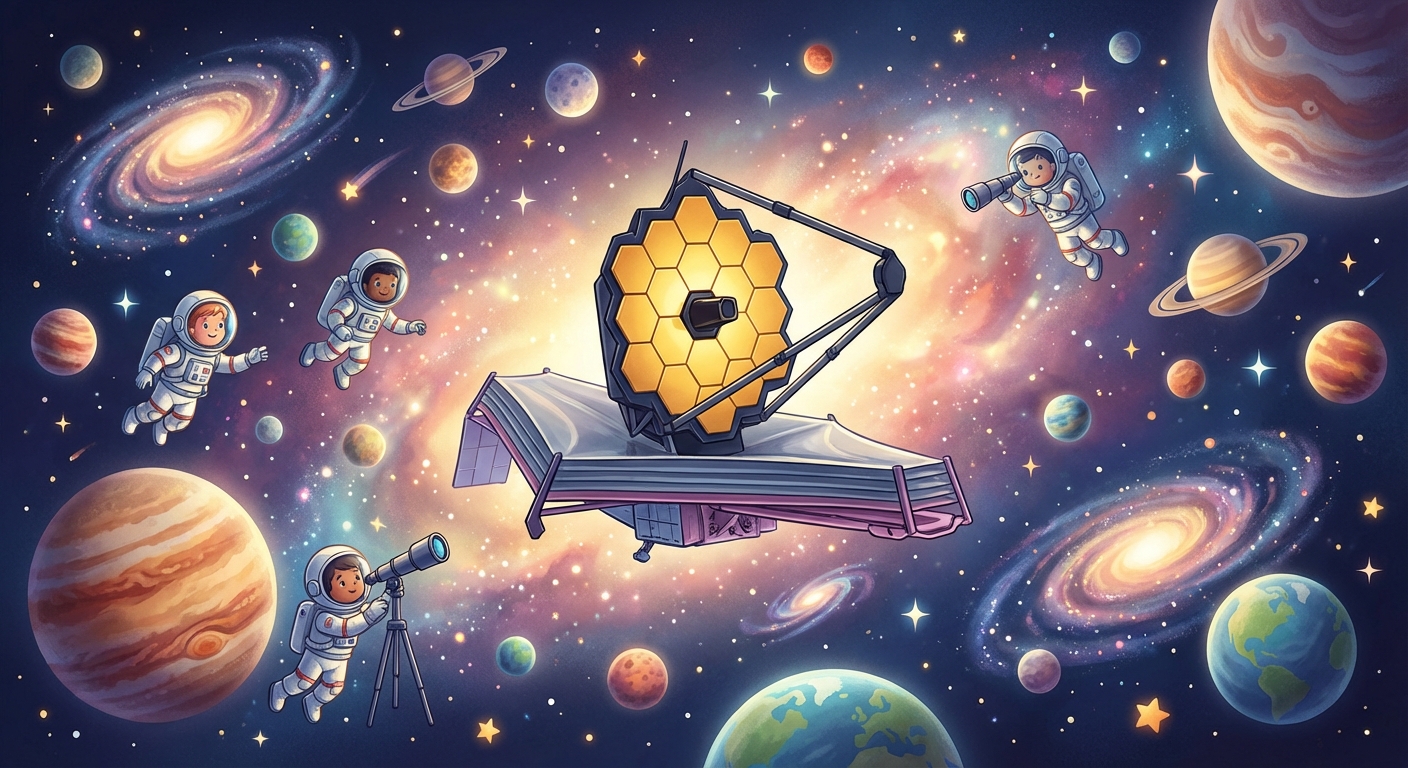
The Amazing James Webb Space Telescope
Imagine an observatory in space collecting infrared light from extremely distant galaxies. The James Webb Space Telescope (JWST) launched in 2021 and helps scientists study early galaxies, stars, planets, and atmospheres. Let’s explore how it works and what it can teach us about the cosmos.
1. Why We Need a New Telescope
The Problem with Old Telescopes
The Hubble Space Telescope has observed space since 1990 in ultraviolet, visible, and some near-infrared wavelengths. JWST was designed mainly for infrared observations, letting it study wavelengths and faint signals that Hubble cannot detect as well.
Cause ➜ Effect
- Cause: Light from far‑away objects travels billions of years and gets stretched (or “red‑shifted”) into infrared wavelengths.
- Effect: Infrared instruments can study light that visible-light instruments may miss, although what scientists can observe depends on the object, wavelength, distance, and instrument.
Vocabulary: Infrared – invisible electromagnetic radiation with wavelengths longer than visible red light. Warm objects emit infrared radiation, but “infrared” and “heat” are not identical words.
2. How JWST Works
A Giant Mirror
JWST’s primary mirror is 6.5 meters (about 21 feet) wide—almost three times Hubble’s mirror diameter. It is made of 18 hexagonal segments that folded together for launch and opened in space.
- Cause ➜ Effect: A larger mirror gathers more light, so the telescope can see fainter, more distant objects.
Sunshield – The Space Blanket
To detect faint infrared signals, JWST must stay Extremely Cold (around –233 °C). It carries a five‑layer sunshield the size of a tennis court that blocks heat from the Sun, Earth, and Moon.
The Instruments
JWST has four main scientific instrument systems with imaging, spectroscopy, and guidance capabilities:
| Instrument | What It Does |
|---|---|
| NIRCam (Near‑Infrared Camera) | Takes sharp pictures of stars and galaxies. |
| NIRSpec (Near‑Infrared Spectrograph) | Splits light into a rainbow to study chemical ingredients. |
| MIRI (Mid‑Infrared Instrument) | Looks at cooler objects like dust clouds and forming planets. |
| FGS/NIRISS (Fine Guidance Sensor / Near Infrared Imager and Slitless Spectrograph) | Guides the telescope; NIRISS can image and take spectra, including for some exoplanet studies. |
Vocabulary: Spectrograph – an instrument that spreads light into a spectrum, like a prism, revealing the composition of the source.
3. What JWST Has Discovered So Far
- First Images: NASA and its partners released JWST’s first full-color images and spectra in July 2022. A separate image of the Pillars of Creation followed in October 2022.
- Ancient Galaxies: JWST has found and helped confirm very distant galaxies seen as they existed within the universe’s first several hundred million years.
- Exoplanet Atmospheres: By studying spectra, JWST can detect some molecules in exoplanet atmospheres. A molecule alone is not proof of life, and JWST has not discovered extraterrestrial life.
Did you know? 🌟 JWST’s beryllium mirror segments have a thin gold coating because gold reflects the infrared wavelengths JWST studies efficiently and remains stable in the telescope’s environment.
4. Mini Experiment: “make Your Own Infrared Detector”
You don’t need a space telescope to explore infrared—just a few household items!
Materials
- A regular TV remote control
- A smartphone with a camera
Steps
- Turn on the remote’s infrared LED by pressing any button.
- With an adult’s permission, open a phone camera and point the remote’s light-emitting tip toward the camera lens. Do not point it into anyone’s eyes.
- While viewing the tip on the phone screen, press a remote button. The infrared LED may appear as a pale flashing light even though your eyes cannot see it directly.
- Some phone cameras filter infrared strongly, so the light may be faint or invisible. Try the front-facing camera with the adult’s permission, or stop if it still does not appear.
Safety Tip: Never look directly at the LED with your eyes, and don’t point the remote at anyone’s face.
James Webb Telescope Quiz
Keep Exploring
Compare a James Webb picture with an older Hubble shot and share what details pop out. Ask where you’d aim the telescope next and why.