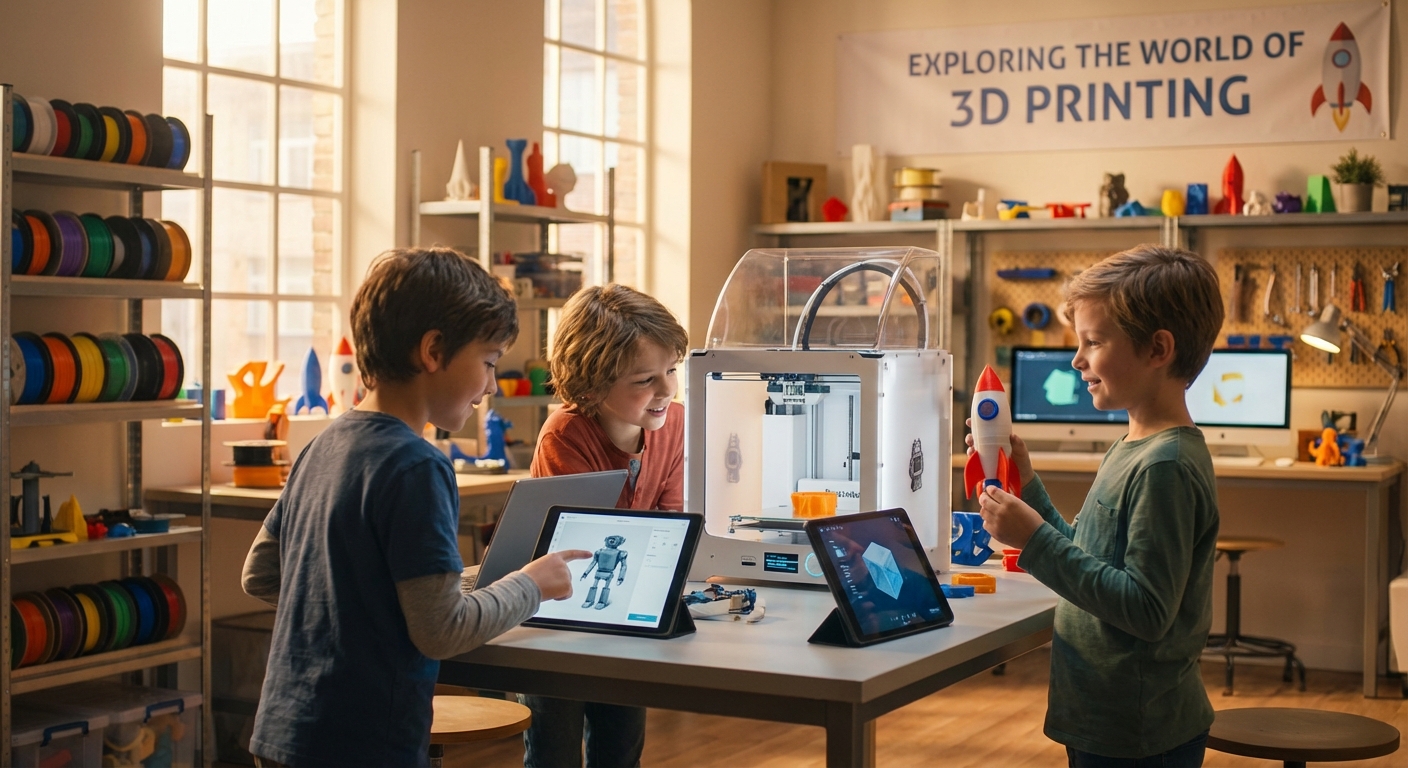
Exploring the World of 3‑d Printing
Imagine you could turn a drawing on paper into a real‑life object that you can hold, play with, or even wear. That’s exactly what 3‑d Printing does! In this adventure we’ll learn how the technology works, see where it’s used, and even try a tiny experiment at home. Ready to become a junior maker? Let’s dive in!
1. What Is 3‑d Printing?
A 3‑d Printer is a machine that creates three‑dimensional objects layer by layer, kind of like building a sandwich one slice at a time.
- Three‑dimensional means the object has height, width, and depth—just like a real toy, not a flat picture.
- Layer‑by‑layer is the cause, and the effect is that the printer can make very detailed shapes that would be hard to carve by hand.
Why Does This Matter? Because it lets inventors quickly turn ideas into prototypes (a Prototype is an early model used to test a concept) without needing expensive factories.
2. How Does a 3‑d Printer Work?
-
Design – First, a computer program (called Cad software) draws a digital model of the object.
-
Slicing – The program cuts the model into thin horizontal slices, like a loaf of bread.
-
Printing – The printer follows those slices:
- The Extruder (a heated nozzle) pushes out melted plastic called Filament.
- The filament solidifies almost instantly, forming one thin layer.
- The printer moves the nozzle up and repeats the process until the object is complete.
Cause And Effect:
-
Cause: The filament is heated.
-
Effect: It becomes liquid and can be shaped.
-
Cause: The printer cools the liquid quickly.
-
Effect: The material hardens, locking the layer in place.
Key Vocab:
- Extruder – the part that squeezes melted material out of the printer.
- Filament – a long, thin strand of plastic (or sometimes metal) that the printer melts.
- Resolution – how fine each layer is; higher resolution means smoother objects.
3. Everyday Examples
| Where You Might See It | What Was Printed | Why It Helps |
|---|---|---|
| Schools | Puzzle pieces, scientific models | Students can hold a model of a volcano or a dinosaur bone. |
| Hospitals | Custom prosthetic limbs | Doctors can create a perfect fit for each patient. |
| Toy Stores | Mini‑figures and accessories | Designers can test new toys quickly before mass‑producing them. |
| Space Agencies | Rocket nozzle parts | Parts can be made on the International Space Station, saving a costly launch. |
Cause And Effect In Action:
- Cause: A doctor needs a prosthetic that matches a child’s arm.
- Effect: A 3‑D printer makes a perfectly shaped piece in a day, instead of waiting weeks for a factory.
4. Did You Know?
- The First 3‑d Printer was built in 1983 (or earlier, depending on the specific invention) and used a completely new method to create objects layer by layer.