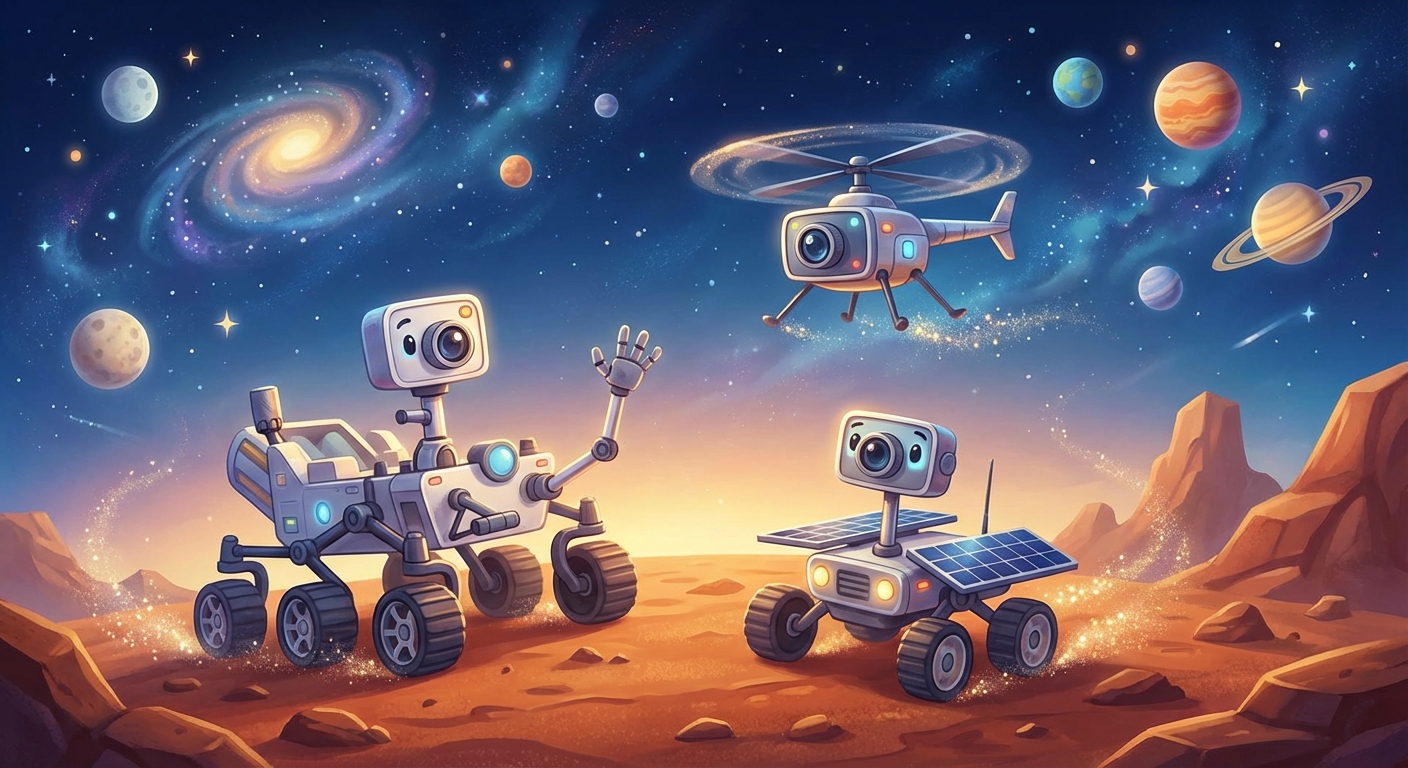
🚀 Meet the Mars Rovers!
Far, far away from Earth is the red planet Mars. To learn about it, scientists send special robots called Rovers. Rovers drive on the ground, take pictures, and tell us what Mars is like.
1. What Is a Rover?
A rover is a small car that can move on its own.
- It has wheels, like a toy car.
- It carries cameras, tools, and a computer that thinks for it.
- It talks to Earth through radio waves, so scientists can hear its discoveries.
2. How Rovers Travel to Mars
First, the rover rides on a big rocket. The rocket blasts off from Earth and flies through space. After a long trip (about 7 months!), the rover lands on Mars using a special sky‑diving system called a Parachute and a Soft‑landing Rocket.
3. What Rovers Do on Mars
- Take Pictures of rocks and the sky.
- Collect Soil to see if tiny life could live there.
- Drive Over Hills and send the route back to us, just like a video game map.
4. Imagine You Are a Rover!
Picture yourself rolling over dusty hills, spotting a bright orange rock, and sending a selfie back to your friends on Earth. What would you explore first?
Did You Know?
The rover Curiosity is about the size of a small car and carries a tiny laboratory that can sniff out chemicals, just like a detective! 🕵️♂️
Conclusion – Keep Looking Up!
Mars rovers show us that even far‑away places can be explored. One day you might design your own rover or become a space scientist. Keep asking questions, looking at the stars, and dreaming big! 🌟