What Are Ecosystem Services?
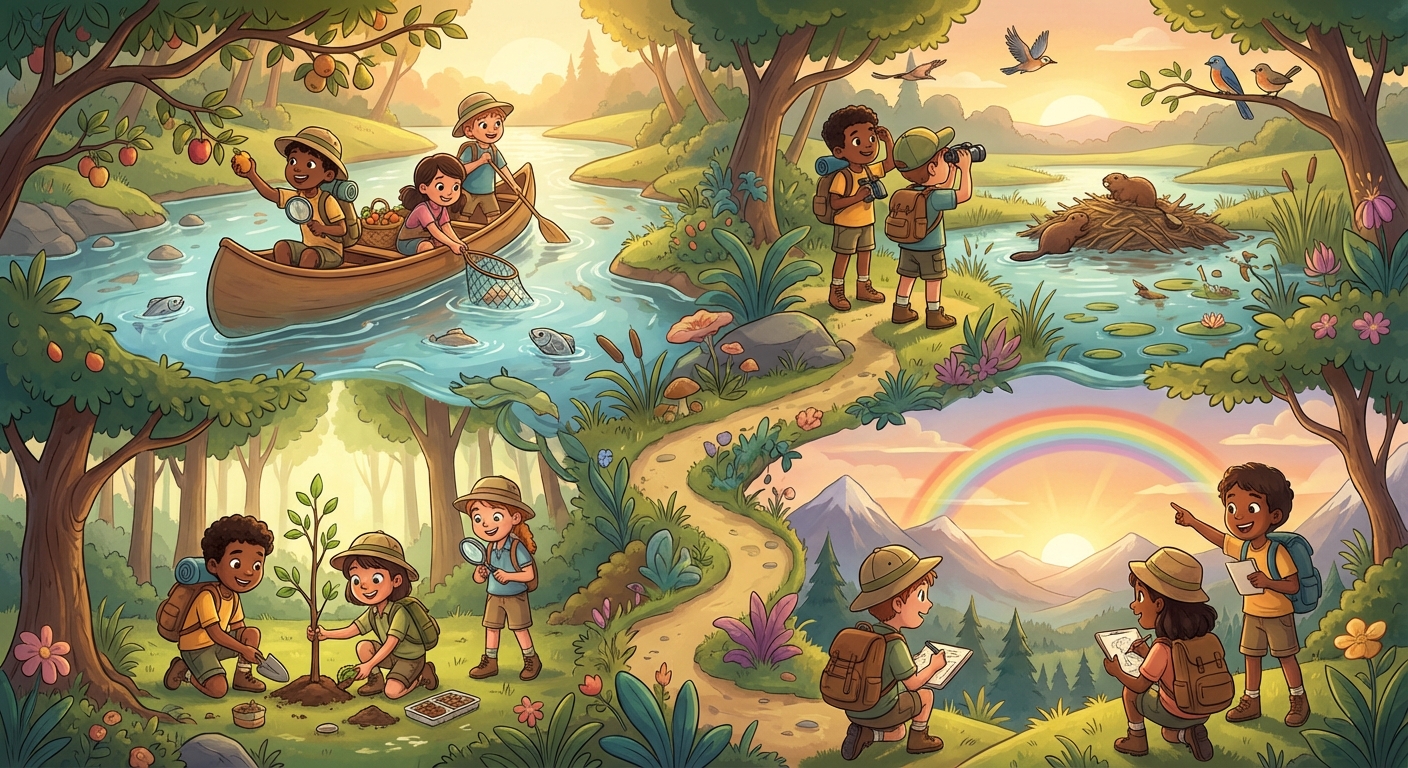
Every time you drink water, eat an apple, or enjoy a sunny park, you’re using a Service that nature provides. Scientists call these benefits Ecosystem Services. They are the “gifts” that forests, rivers, bees, and even tiny microbes give us so we can live healthy, happy lives. Let’s explore how nature works behind the scenes and why we need to protect it!
1. The Four Types of Ecosystem Services
| Service Type | What It Means | Everyday Example |
|---|---|---|
| Provisioning | Supplies we can take directly, like food and water. | Fresh strawberries from a garden; clean drinking water from a river. |
| Regulating | Helps keep the environment stable, such as cleaning the air. | Trees absorb carbon dioxide (CO₂) and release oxygen. |
| Cultural | Gives us inspiration, recreation, and spiritual value. | Hiking in a forest, painting a sunset, learning about wildlife. |
| Supporting | The hidden “building blocks” that make the other services possible. | Soil microbes breaking down dead leaves into nutrients for new plants. |
Word Spot: Carbon sequestration – the process of storing carbon from the atmosphere in trees, soil, or oceans.
2. How Ecosystem Services Work (cause & Effect)
-
Pollination – Bees, butterflies, and birds move pollen from one flower to another.
Cause: Bees visit a flower for nectar.
Effect: The flower can produce seeds, which grow into new plants that give us fruit and oxygen. -
Water Filtration – Wetlands act like natural sponges.
Cause: Rainwater passes through layers of plants and mud.
Effect: Impurities are trapped, leaving cleaner water that flows downstream to towns and farms. -
Soil Fertility – Earthworms chew through leaf litter, mixing it into the soil.
Cause: Worms digest organic matter and excrete nutrient‑rich castings.
Effect: Plants get the nutrients they need to grow strong, which feeds animals and people.
If any of these “helpers” disappear, the chain breaks: fewer pollinators → fewer fruits → less food for us and wildlife.
3. Did You Know? 🤔
- A mature tree can store a substantial amount of carbon, but the amount varies widely with its species, size, age, location, and what happens to its wood later.
- Mangrove Forests protect coastlines from storm waves while also providing nursery habitats for fish.
- The Amazon Rainforest cycles a huge amount of oxygen and carbon. Its plants produce oxygen, but life and decomposition there use nearly as much, so the rainforest’s greatest global value is not supplying 20% of the oxygen we breathe.
4. Mini Model: Filter Particles From Water
What You’ll Need
- Two clear plastic cups
- Tap water
- A handful of soil (preferably from a garden)
- A small piece of clean cloth or coffee filter
- A timer (or a watch)
Steps
- Add the same amount of tap water and a spoonful of soil to each cup. Stir gently.
- Leave Cup A alone so some particles can settle.
- Put the cloth or coffee filter over a clean container and slowly pour Cup B through it.
- After 10 minutes, compare the water above the settled soil in Cup A with the filtered water from Cup B.
- Do not drink either sample. Clearer-looking water can still contain germs or dissolved pollutants.
Observations
- Write down which cup had the clearest water.
- Note differences in color and visible particles. Do not smell the samples closely.
- Discuss how settling and a physical filter remove some particles but do not make water safe to drink. Real wetlands use soils, plants, microbes, and many other processes.
Quiz: Test Your Knowledge
-
Which ecosystem service is the bee providing?
a) Provisioning
b) Regulating ✓
c) Cultural
d) Supporting -
What is the main benefit of wetlands mentioned in the article?
a) They produce fruit.
b) They act as natural sponges that filter water. ✓
c) They provide playgrounds.
d) They store gold. -
Why is there no single carbon-storage number for every mature tree?
a) Trees contain no carbon.
b) Species, size, age, location, and the wood’s future all matter. ✓
c) Carbon can only be measured in oceans.
d) Every tree is exactly the same.
Remember, every little action helps protect the amazing services nature gives us!