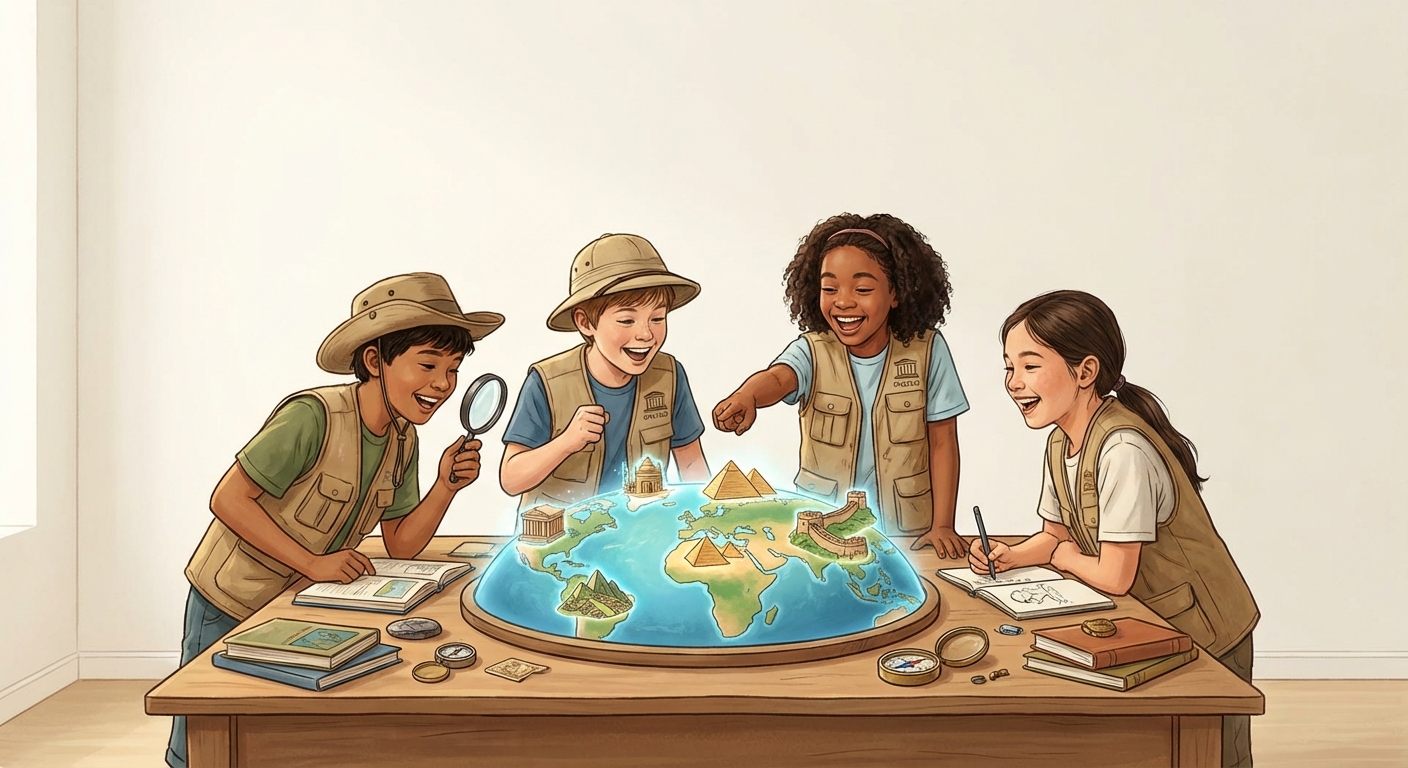
Amazing UNESCO World‑culture Sites
UNESCO’s World Heritage Committee can add places of outstanding cultural or natural value to the World Heritage List. Countries nominate places and agree to protect them. Cultural sites can help us learn how people lived, created art, built communities, and understood their world.
1. The Great Wall of China – A Stone Snake 🐍
What It Is: A vast network of walls, trenches, forts, and natural barriers built in different eras. Official surveys count more than 20,000 km (about 13,000 miles) across all known historical sections, although totals depend on which sections are included.
New Vocab:
- Fortification – a strong defensive wall or building.
- Dynasty – a series of rulers from the same family.
Why It Was Built (Cause → Effect):
Cause: Ancient Chinese emperors wanted to protect their lands from invading armies.
Effect: Different states and dynasties built and rebuilt walls, forts, and signal towers. These defenses could slow movement and help warn troops, but they did not stop every invasion.
Did You Know? The wall isn’t a single continuous line; it’s a patchwork of sections built by different dynasties over 2,000 years!
2. Machu Picchu – The Lost City in the Clouds
What It Is: A hidden Inca citadel high in the Andes Mountains of Peru, perched 2,430 m (8,000 ft) above sea level.
New Vocab:
- Citadel – a fortified city or stronghold.
- Terrace – a flat, step‑like platform built into a slope.
Cause → Effect:
Cause: Inca builders needed to construct on a steep, rainy mountain site.
Effect: They created terraces, drainage channels, and carefully fitted stone buildings. Scholars still debate Machu Picchu’s exact purposes.
Did You Know? Local Indigenous communities knew Machu Picchu long before Hiram Bingham visited in 1911. Describing his visit as a “discovery” ignores those communities and earlier knowledge of the site.
3. The Pyramids of Giza – Ancient Egyptian Marvels
What It Is: Three giant stone pyramids and the Great Sphinx near Cairo, built as tombs for pharaohs over 4,500 years ago.
New Vocab:
- Pharaoh – the king or ruler of ancient Egypt.
- Sarcophagus – a stone coffin, often decorated with carvings.
Cause → Effect:
Cause: Egyptian leaders believed the afterlife was a continuation of life on Earth and wanted grand tombs to protect their bodies and treasures.
Effect: They mobilized thousands of workers to quarry limestone and construct the pyramids, leaving us with some of the world’s most precise ancient architecture.
Did You Know? The Great Pyramid was the tallest man‑made structure on Earth for more than 3,800 years!
4. The Historic Centre of Florence – Cradle of the Renaissance
What It Is: A compact city in Italy filled with art, museums, and architecture that sparked the Renaissance, a period of great cultural rebirth.
New Vocab:
- Renaissance – a “rebirth” of learning, art, and science in Europe (14th‑17th centuries).
- Patron – a person who supports artists or scholars, often by giving money.
Cause → Effect:
Cause: Wealthy families like the Medici funded artists, scientists, and writers.
Effect: Patronage helped artists, architects, writers, and scholars work in Florence, contributing to Renaissance art and learning. Many other cities and communities also shaped the Renaissance.
Did You Know? Florence’s famous “Duomo” dome was built using clever techniques that allowed it to rise without traditional wooden scaffolding from the ground. Filippo Brunelleschi designed a self-supporting structure with special brick patterns and internal platforms as the dome was constructed upwards.
Mini Quiz & Experiment
Quiz (circle the correct answer)
-
Which UNESCO site was built to stop invading armies?
- A) The Great Wall of China
- B) Machu Picchu
- C) The Historic Centre of Florence
-
Which site was built by the Inca civilization?
- A) The Pyramids of Giza
- B) Machu Picchu
- C) The Great Wall of China
-
What does UNESCO ask countries to do after a place joins the World Heritage List?
- A) Protect and manage it
- B) Move it to a museum
- C) Close it forever
Answers
- A
- B
- A
Activity: Make a Heritage Stewardship Plan
Choose a place in your community that matters to people. Draw it, list what could damage it, and write three actions that could help care for it. Ask before visiting or photographing private or sacred places.