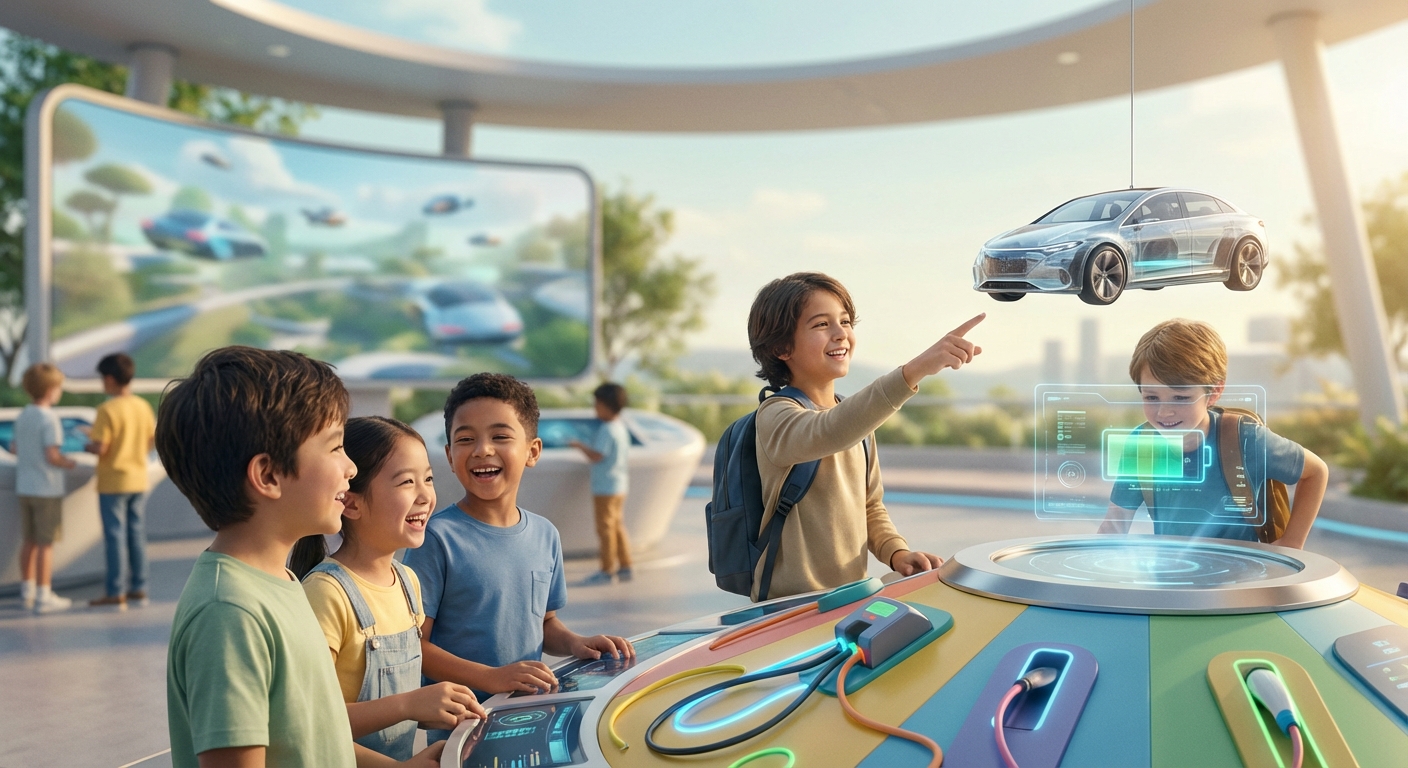
️ Zooming into the Future: Electric Vehicles
Imagine a car that runs without the roar of a gasoline engine and without puffing out smoky clouds. That’s an Electric Vehicle (EV) – a vehicle that gets its power from electricity stored in a Battery instead of burning fuel. In this adventure we’ll explore how EVs work, why they’re good for our planet, and even try a tiny experiment at home!
1. How an Electric Vehicle Works
| Part | What It Does | Simple Explanation |
|---|---|---|
| Battery | Stores electricity | Like a giant, rechargeable flashlight |
| Motor | Turns the wheels | A quiet, powerful spin‑maker |
| Controller | Tells the motor how fast to go | The “brain” that decides speed |
| Charging Port | Where the car plugs into power | The car’s “eating” spot for electricity |
When you press the accelerator, the controller sends electricity from the battery to the motor, which makes the wheels turn. No gasoline, no exhaust pipe!
Did You Know? The first electric car was built in the 1800s—long before the first gasoline car! 🚗
2. Why Electric Vehicles Help the Environment
Cause → Effect
-
Cause: Gasoline cars burn fuel, releasing carbon dioxide (CO₂) and air pollutants.
-
Effect: These gases trap heat in the atmosphere, leading to Global Warming and Climate Change.
-
Cause: EVs run on electricity, and many places now get that electricity from Renewable sources like wind and solar.
-
Effect: Fewer greenhouse gases are released, keeping the air cleaner and the planet cooler.
New Vocabulary
- Emissions – gases or particles released into the air (e.g., from car exhaust).
- Renewable – energy that comes from sources that naturally replenish, such as sunlight or wind.
- Efficiency – how well a machine turns energy into useful work; higher efficiency means less waste.
3. Real‑world Examples
| Vehicle | Typical Range (miles) | Fun Fact |
|---|---|---|
| Nissan Leaf | 150 | Often used for city deliveries |
| Tesla Model 3 | 350 | Can travel from New York to Washington, D.C. on one charge |
| Chevrolet Bolt | 259 | Holds more energy than a small home battery! |
Kids can spot EVs on the road—look for a quiet car with a charging cable plugged into a wall or a special Charging Station at a mall or school.
4. Mini Investigation: Follow the Energy
Materials:
- Paper
- Pencil or crayons
- A picture of an electric car or battery-powered toy
Steps:
- Draw four boxes labeled charger, battery, motor, and wheels.
- Connect them with arrows to show how electrical energy reaches the motor and becomes motion.
- Add an arrow for energy that becomes heat or sound instead of motion.
- Compare your diagram with a battery-powered toy. Do not open, rewire, or short-circuit a battery.
Quick Quiz
-
What Stores Electricity In An Electric Vehicle?
a) Engine b) Battery c) Fuel tank -
Which Word Means “Energy That Never Runs Out”?
a) Fossil b) Renewable c) Exhaust -
True Or False: Electric vehicles produce no emissions
a) True b) False ✓
Congratulations! You’ve learned how electric cars work, why their total impact depends partly on how electricity and batteries are made, and how energy reaches their wheels.