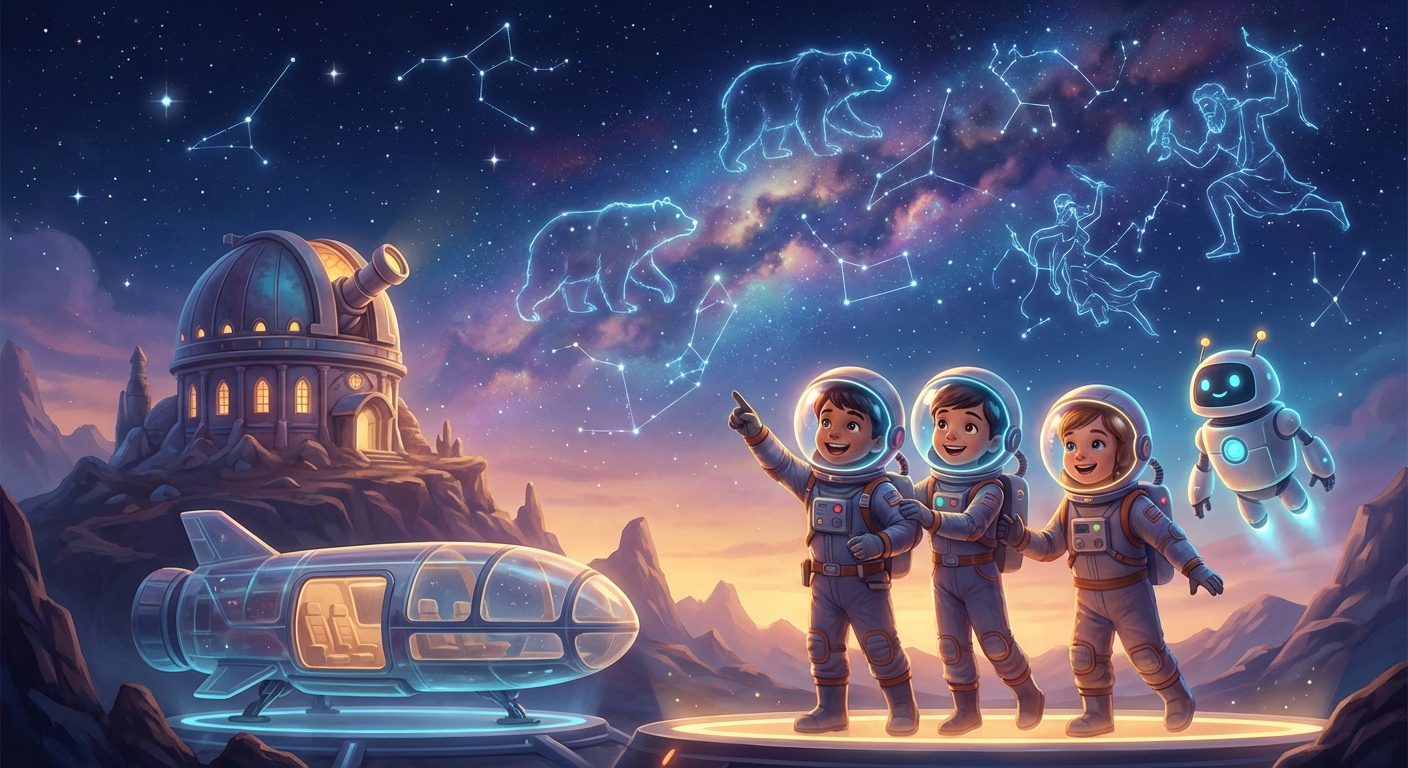
The Great Alien Search: Exploring the Cosmos
Welcome, junior astronomers! Ever wondered if we’re alone in the universe? Let’s blast off on a cosmic adventure to learn how scientists look for aliens and what the stars can teach us.
The night sky is a gigantic puzzle made of stars, planets, moons, and clouds of gas. SETI means the search for extraterrestrial intelligence; it is a field of research carried out by different organizations and scientists. Astrobiology also looks more broadly for possible signs of life.
1. How Do We Listen to the Stars?
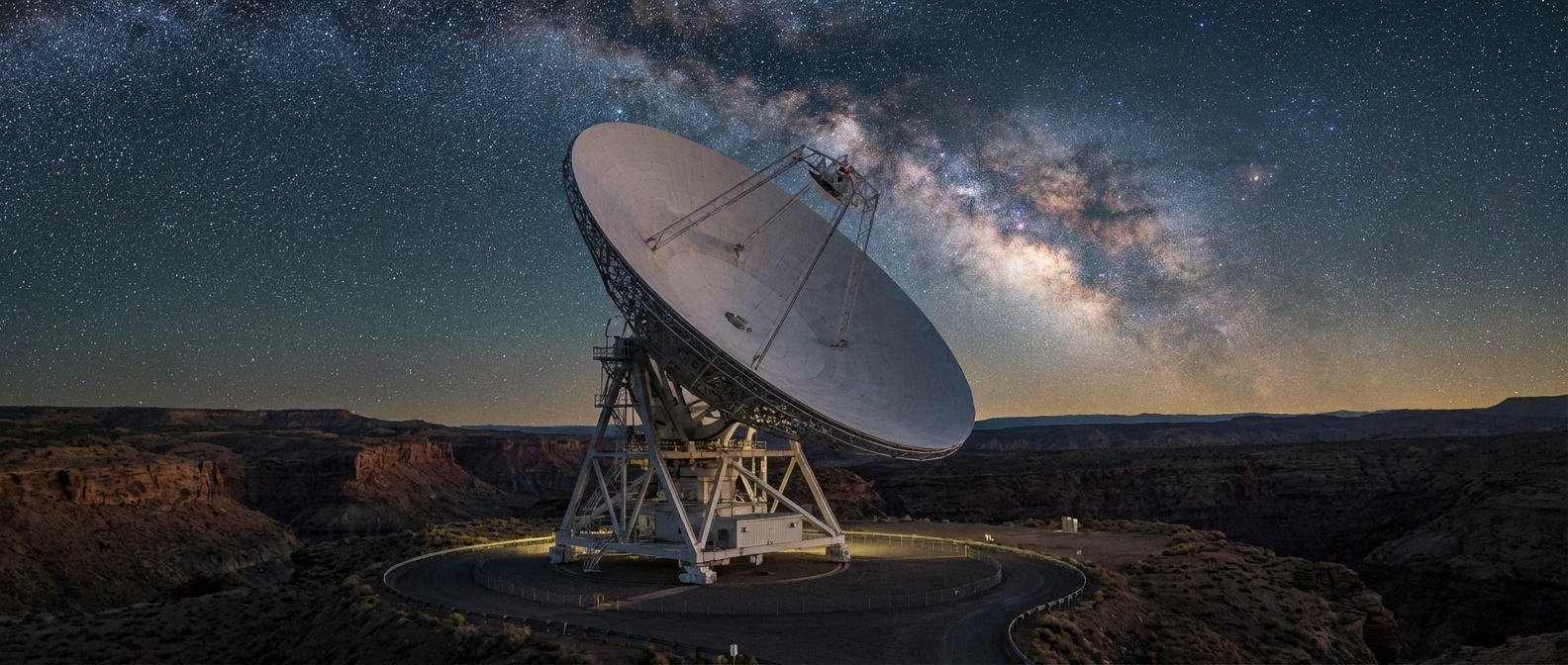
- Radio Telescopes: Giant “ears” on Earth that catch faint radio signals from space.
- Spectroscopy: A fancy word for breaking light into a rainbow to see what chemicals are present.
Cause And Effect: A combination of gases in an exoplanet atmosphere could be a clue worth investigating. Oxygen alone would not prove life because nonliving processes can also produce it.
Did You Know? The famous “Wow! signal” was a brief, strong radio burst in 1977 that still puzzles scientists.
2. Where Might Aliens Live?
- Exoplanets: Planets that orbit other stars. Scientists have confirmed thousands of them.
- Habitable Zone: A range of distances where a rocky planet with a suitable atmosphere might have liquid water on its surface. Being in this zone does not mean a planet is inhabited—or even habitable.
Example: Kepler‑452b is an exoplanet about 1,400 light‑years away that sits in its star’s habitable zone.
Cause And Effect: Distance from a star affects temperature, but an atmosphere, the kind of star, a planet’s orbit, and many other factors also matter.
3. Signals from Space
Most SETI projects listen or look for unusual signals. A few deliberate messages have also been transmitted. The Arecibo Message, sent once toward the distant globular cluster M13 in 1974, encoded numbers and simple scientific diagrams in binary.
Mini Activity – Encode a Tiny Message
- Draw a 5-by-5 grid on paper.
- Use 1 for a filled square and 0 for an empty square.
- Make a simple picture such as an arrow or letter, then write its 25 binary digits row by row.
- Give only the digits to a partner and see whether they can reconstruct the picture.
This models one way information can be represented. It does not solve the much harder problem of helping an unknown receiver understand what the symbols mean.
4. The Search Gets Smarter: AI and Space Telescopes
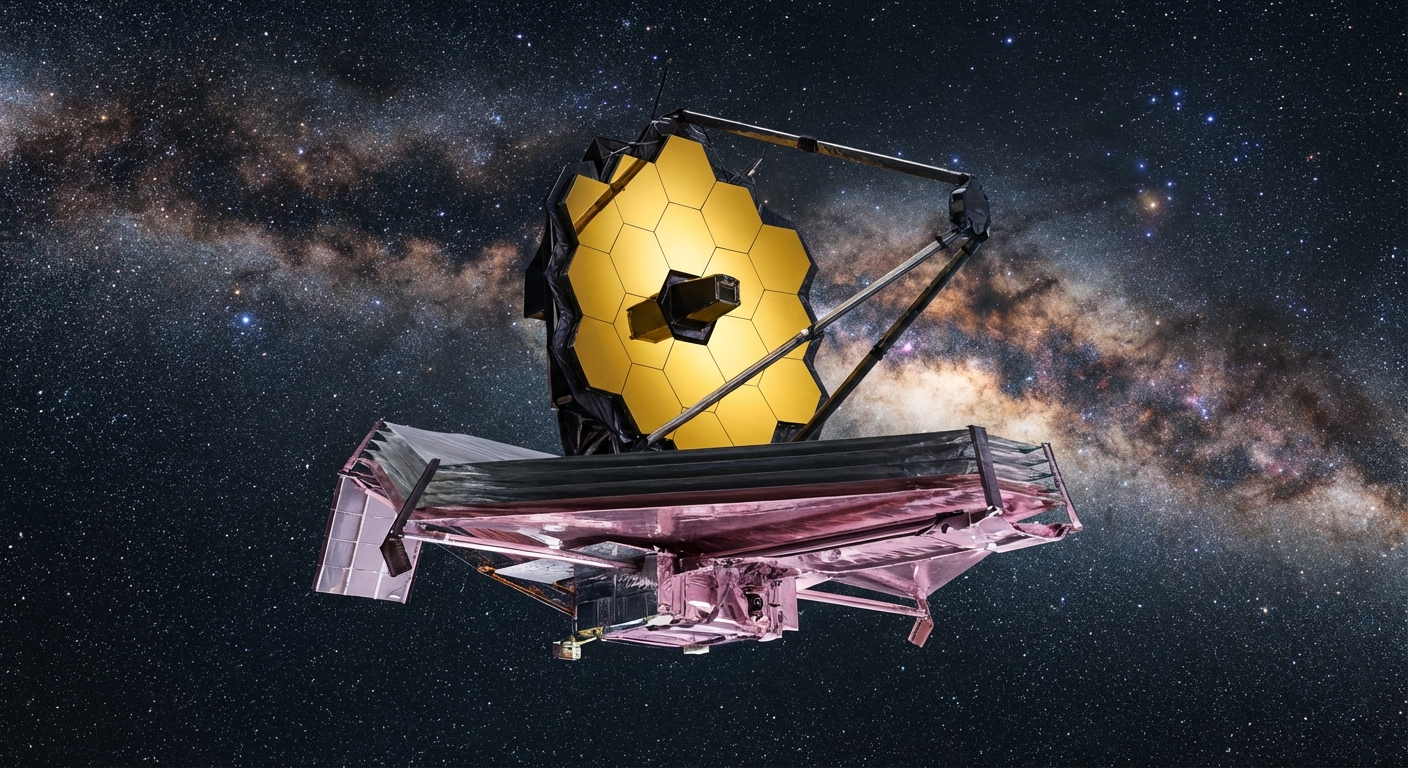
The James Webb Space Telescope observes infrared light and can study some exoplanet atmospheres. Infrared observations can reveal temperature-related information and chemical fingerprints, depending on the target and method.
Machine-learning tools can help researchers sort large datasets and find patterns, but people must test the results and rule out instrument errors or ordinary sources.
Cause And Effect: More data + smarter computers = faster discovery of potential alien habitats.
Did You Know? A possible signal is only a starting point. Independent observations and careful analysis are needed before scientists accept a discovery.
Simple Activity – “alien Habitat Diorama”
What You Need:
- A shoebox, construction paper, clay, paper star cutouts, and markers
- Pictures of exoplanets (print from a kid‑friendly astronomy site)
Steps:
- Ask a grown-up to cut a “window” in the shoebox, or use it without cutting.
- Use clay to shape a planet and place it in the box.
- Add paper stars and draw a possible habitable zone around a star.
- Write a short story about a creature that could live there, using at least three new words you learned (e.g., spectroscopy, exoplanet, habitable).
Display your diorama and share the story with family—explain why that planet might be a good place for life.
Conclusion – Keep Looking Up!
The cosmos is a Vast Laboratory where every twinkle could hide clues about alien life. By learning how scientists listen, look, and think, you become a junior explorer ready to ask bold questions. Keep watching the night sky, building experiments, and dreaming—who knows, maybe You will discover the next “Wow!” signal. 🌟
Adventure awaits among the stars; the universe is yours to explore!